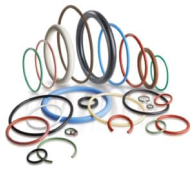
Global O-Ring and Seal has developed these o-ring groove design and gland dimension guidelines to help you size a correct gland for face/flange, static, dynamic and dovetail seals. Use the interactive O-Ring Groove Design Calculator below to apply them in seconds — choose an AS568 series and groove type to get gland depth, width, squeeze and corner radii, with built-in compression, extrusion/pressure and concentricity checks.

Numerous factors go into a gland/groove design — static or dynamic application, pressure, the fluid being sealed, and the tolerances of both the o-ring and the groove — so treat the calculator as a starting point and confirm it against your application. The full design tables, dimensional references and engineering guidance behind the tool are in the Supporting Documentation below.

Groove cut around a piston or shaft; the O-ring is squeezed between the groove bottom and the bore wall. Not sure? Piston/shaft is the most common — pick it and adjust.
bore wallODIDWidthDepth rodODIDWidthDepth centerODIDWidthDepth centerODIDWidthDepth

Piston / shaft groove — the O-ring is squeezed between the groove bottom and the bore wall. Tap a field below and its dimension lights up.

in
Smaller of the two diameters.
in
Larger of the two diameters.
in
Radial depth. Auto = (OD−ID)÷2.
in
Axial width of the groove.
The finder uses published O-ring design rules — target squeeze (judged by cross-section), gland-fill, and stretch. Inch (AS568) sizes follow the Parker O-Ring Handbook ORD 5700 tables; metric sizes follow ISO 3601-2 (Housing dimensions), with off-standard cross-sections shown as general guidance. Sizes are matched against Global O-Ring’s stocked AS568 and metric sizes. Results are a starting point; final selection should account for tolerances, fluid/thermal swell, pressure, and material. Want a person to confirm it? Request a quote or call 832-448-5550 — most of what we sell is in stock in Houston.
DWHCSR DWHCSR mating face (pressed down)DWCSR DWCSR

Static radial gland — designed clearance gap, no motion.

in
Nearest stocked AS568 dash in this series — with a machine-to-fit tip if your ID is off-standard.

Design Validator

Real-time checks against the methodology described further down this page — compression-ratio extremes, extrusion-pressure limits, and concentric clearance.

Compression Check

Squeeze at nominal dimensions and at both tolerance extremes. Each value is checked against the published squeeze range for the selected series and groove type.

Extrusion / Pressure Check

Enter your application pressure, durometer, and clearance gap. The calculator returns the max safe pressure for that combination (Parker EB-1010 limits) and whether your design fits.

psi
in

Concentricity / Clearance Helper

No measured clearance handy? Enter bore and shaft/piston diameters. Assume all clearance can shift to one side — the full diametric clearance is what the extrusion check needs.

in
in

Extrusion-pressure limits derived from the Parker O-Ring Handbook (ORD 5700 / EB-1010). Values assume continuous pressure at room temperature on elastomeric compounds (Buna-N, FKM/Viton, EPDM). For FFKM, PTFE, polyurethane, high-temperature service, pulsing pressure, or Rapid Gas Decompression, request engineering review.

Sources & standards. Inch gland dimensions and squeeze ranges follow the Parker O-Ring Handbook (ORD 5700) and SAE AS4716: static glands per Design Chart 4-2, face seals per Design Chart 4-3, dovetail glands per the dovetail charts, and dynamic glands per the ORD 5700 reciprocating-seal tables. Cross-section sizes & tolerances per SAE AS568 and ISO 3601-1; metric housing per ISO 3601-2. Extrusion limits per ORD 5700 / Parker EB-1010.
Values are a starting point — the final design must account for tolerance extremes, fluid swell, thermal expansion, and concentricity. Request a quote or call 832-448-5550.
'; } function scnCard(r, tag, depth){ var isBest=tag.indexOf("Best")===0, isClose=tag.indexOf("Closest")===0; var cls = isBest?"is-best":(isClose?"is-near":"is-alt"); var tcls = isBest?"best":(isClose?"near":"alt"); // squeeze cell — judged against this size's own cross-section range var sqNote = r.sqOk?"in range":(r.sq>r.sqMax?"too tight":"too loose"); var sqCls = r.sqOk?"ok":(r.sq>r.sqMax?"bad":"bad"); var fillNote = r.fill==null?"":(r.fillOk?"ok":(r.fill>100?"won't fit":"tight")); var fillCls = r.fill==null?"ok":(r.fillOk?"ok":(r.fill>100?"bad":"warn")); var dimNote = r.dimOk?"ok":(r.dim<0?"loose":"too much"); var dimCls = r.dimOk?"ok":"bad"; var why = r.ok ? "All three checks pass for this seal type." : "Closest standard size, but "+ [!r.sqOk?"squeeze is "+(r.sq>r.sqMax?"too high":"too low"):null, !r.fillOk?(r.fill>100?"the O-ring is too big for this groove":"the groove is nearly full"):null, !r.dimOk?"the diameter doesn't match well":null].filter(Boolean).join(", ")+"."; var sizeLine = dimBoth(r.id)+" ID × "+dimBoth(r.cs)+" CS"; var head='AS568 -'+r.d, shopHref=SHOP+r.d, shopLabel='Shop size -'+r.d+' →'; if(r.sys==="M"){ var idmm=(r.id_mm!=null?r.id_mm:r.id*25.4), csmm=(r.cs_mm!=null?r.cs_mm:r.cs*25.4); head='Metric '+fmtN(idmm)+'×'+fmtN(csmm)+' mm'; sizeLine=fmtN(idmm)+' mm ID × '+fmtN(csmm)+' mm CS  ('+r.id.toFixed(3)+'″ × '+r.cs.toFixed(3)+'″)'; shopHref=SHOP+encodeURIComponent(csmm+'X'+idmm); shopLabel='Shop this size →'; } // size-landing (all materials), matches AS568 behavior return '
'+ '
'+head+' '+sizeLine+'
'+ ''+tag+'
'+ '
'+ metric("Squeeze", r.sq.toFixed(1)+"%", sqCls, sqNote)+ metric(r.dimLabel, (r.dim>=0?"+":"")+r.dim.toFixed(1)+"%", dimCls, dimNote)+ metric("Gland fill", r.fill==null?"—":r.fill.toFixed(0)+"%", fillCls, fillNote)+ '
'+ '
'+ '
'+ '
'+why+'
'+ '
Squeeze target '+Math.round(r.sqMin)+'–'+Math.round(r.sqMax)+'% · '+r.sqSrc+'
'+ '
'+ ''+shopLabel+''+ 'Quote this size'+ '
'; } function customPanel(depth, gID, gOD, idealPct, hasPass){ var sid=idealPct; var csIdeal = depth/(1-sid/100); var idIdeal = (state.seal==="rod"||state.seal==="face-internal") ? (gOD-2*csIdeal) : gID; var spec = "O-ring ID ≈ "+dimBoth(idIdeal)+" · cross-section ≈ "+dimBoth(csIdeal)+ " · groove: ID "+dimBoth(gID)+", OD "+dimBoth(gOD)+", depth "+dimBoth(depth); var head = hasPass ? "Prefer an exact fit? A custom size hits the ideal squeeze" : "This looks like a non-standard groove"; var lead = hasPass ? "The standard size(s) above will work. If you want squeeze right in the middle of the range, a made-to-spec O-ring is the exact match:" : "No off-the-shelf AS568 size lands cleanly in this groove — which is normal for grooves that weren’t cut to a standard. Here’s the O-ring that fits it, which we can make to order:"; return '
'+ '

'+head+'

'+lead+'

'+ '
'+spec+'
'+ '
'+ ''+ 'Request this custom O-ring'+ '
'+ '

Options for non-standard sizes: '+ 'custom molded O-rings, '+ 'vulcanized (spliced) O-rings for larger IDs, or call 832-448-5550 and read off your four measurements.

'+ '
'; } function render(){ var box=$("#fResults"); if(metricState==="idle"){ loadMetric(function(){ if(metricState==="loaded") render(); }); } var gID=num($("#fID")), gOD=num($("#fOD")), depth=num($("#fDepth")), width=num($("#fWidth")); // need at least (ID & OD) or depth, plus width if((gID==null||gOD==null) && depth==null){ box.innerHTML='
Enter at least the groove ID and OD (or a depth), plus the width, then press Find my O-ring.
'; return; } var giIn=gID!=null?toIn(gID):null, goIn=gOD!=null?toIn(gOD):null, dIn=depth!=null?toIn(depth):null, wIn=width!=null?toIn(width):null; if(giIn!=null&&goIn!=null&&goIn<=giIn){ box.innerHTML='
Groove OD must be larger than groove ID. Double-check the two diameters.
'; return; } var isFace = state.seal.indexOf("face")===0; if(isFace){ if(wIn==null && giIn!=null && goIn!=null) wIn=(goIn-giIn)/2; if(dIn==null){ box.innerHTML='
For a face seal, enter the axial groove depth (how deep the groove is cut into the face).
'; return; } if(wIn==null){ box.innerHTML='
Add the groove width (or the ID and OD so we can work it out).
'; return; } } else { if(dIn==null && giIn!=null && goIn!=null) dIn=(goIn-giIn)/2; if(wIn==null){ box.innerHTML='
Add the groove width so we can check gland fill (how much room the O-ring has).
'; return; } if(dIn==null){ box.innerHTML='
Enter the groove depth, or both ID and OD so we can work it out.
'; return; } } var ev=evaluate(giIn,goIn,dIn,wIn); var depthUsed=ev.depth, mode=ev.mode; if(depthUsed==null||depthUsed<=0){ box.innerHTML='
Couldn’t work out the groove depth. Enter it directly.
'; return; } if(!isFace && depth==null){ $("#fDepth").value=(state.unit==="mm"?(depthUsed*25.4):depthUsed).toFixed(3); } if(isFace && width==null){ $("#fWidth").value=(state.unit==="mm"?(wIn*25.4):wIn).toFixed(3); } var allPass=ev.list.filter(function(r){return r.ok;}); var asPass=allPass.filter(function(r){return r.sys!=="M";}); // AS568 (inch) var mPass =allPass.filter(function(r){return r.sys==="M";}); // metric var asClosest=ev.list.filter(function(r){return r.sys!=="M";})[0]; // best AS568 even if it doesn't fully pass var mClosest =ev.list.filter(function(r){return r.sys==="M";})[0]; var cards=[]; if(asPass.length){ // inch fits -> AS568 leads, metric is the bonus option cards.push({r:asPass[0],tag:"Best match"}); if(mPass.length) cards.push({r:mPass[0],tag:"Also fits — metric"}); if(asPass[1]&&cards.length<3) cards.push({r:asPass[1],tag:"Alternative"}); } else if(mPass.length){ // metric fits but no standard inch size does -> always still surface an AS568 cards.push({r:mPass[0],tag:"Best match"}); if(asClosest) cards.push({r:asClosest,tag:"Closest AS568"}); if(mPass[1]&&cards.length<3) cards.push({r:mPass[1],tag:"Alternative"}); } else { // nothing passes cleanly -> show the closest of each if(asClosest) cards.push({r:asClosest,tag:"Closest AS568"}); if(mClosest) cards.push({r:mClosest,tag:"Closest metric"}); } var html=''; html+='
Using gland depth '+dimBoth(depthUsed)+ ' · '+(state.seal.indexOf("face")===0?"face seal":state.motion+" seal")+ '. Squeeze is judged by cross-section — inch sizes per AS568 / Parker O-Ring Handbook ORD 5700, metric per ISO 3601-2. Each result below shows the target range and source it was checked against.
'; html+='
'; if(cards.length){ cards.forEach(function(c){ html+=scnCard(c.r, c.tag, depthUsed); }); } else { ev.list.slice(0,3).forEach(function(r){ html+=scnCard(r,"Closest standard",depthUsed); }); } html+='
'; if(!allPass.length){ html+=customPanel(depthUsed, giIn!=null?giIn:(goIn-2*depthUsed), goIn!=null?goIn:(giIn+2*depthUsed), MODE_IDEAL[mode], false); } box.innerHTML=html; var copyBtn=document.getElementById("fCopy"); if(copyBtn){ copyBtn.addEventListener("click",function(){ var t=document.getElementById("fSpec").textContent; if(navigator.clipboard){ navigator.clipboard.writeText(t); copyBtn.textContent="Copied ✓"; setTimeout(function(){copyBtn.textContent="Copy these specs";},1500); } }); } } // ---- 3-of-4 dimensions: auto-calculate & lock the dependent field ---- var FMAP={id:"#fID",od:"#fOD",depth:"#fDepth",width:"#fWidth"}; var fLocked=null; function fLockEl(el,on){ if(!el)return; el.disabled=!!on; var c=el.closest(".gc-dim"); if(c)c.classList.toggle("is-locked",!!on); } function fRaw(el){ var x=parseFloat(el.value); return isNaN(x)?null:x; } function fFmt(x){ return (Math.round(x*1000)/1000).toString(); } function syncLock(){ var isFace=state.seal.indexOf("face")===0; var third=isFace?"width":"depth", free=isFace?"depth":"width"; fLockEl($(FMAP[free]),false); function uv(k){ if(k===fLocked) return null; return fRaw($(FMAP[k])); } var vid=uv("id"), vod=uv("od"), vth=uv(third); ["id","od",third].forEach(function(k){ if(k!==fLocked) fLockEl($(FMAP[k]),false); }); var have=(vid!=null?1:0)+(vod!=null?1:0)+(vth!=null?1:0); if(have>=2){ if(vid!=null&&vod!=null){ if(vod>vid){ fLocked=third; var e=$(FMAP[third]); e.value=fFmt((vod-vid)/2); fLockEl(e,true);} else { fLocked=null; } } else if(vid!=null&&vth!=null){ fLocked="od"; var e2=$(FMAP.od); e2.value=fFmt(vid+2*vth); fLockEl(e2,true); } else { if(vod>2*vth){ fLocked="id"; var e3=$(FMAP.id); e3.value=fFmt(vod-2*vth); fLockEl(e3,true);} else { fLocked=null; } } } else { fLocked=null; } } function resetLocks(){ fLocked=null; ["id","od","depth","width"].forEach(function(k){ fLockEl($(FMAP[k]),false); }); } ["#fID","#fOD","#fDepth","#fWidth"].forEach(function(s){ var el=$(s); if(el) el.addEventListener("input",syncLock); }); // wire toggles $("#fSeal").addEventListener("click",function(e){var b=e.target.closest("button");if(!b)return;state.seal=b.getAttribute("data-seal"); $("#fSeal").querySelectorAll("button").forEach(function(x){x.classList.toggle("is-active",x===b);}); $("#fSealHint").textContent=SEALHINT[state.seal]; $("#fMotion").style.display = state.seal.indexOf("face")===0 ? "none":"flex"; if(fLocked){ $(FMAP[fLocked]).value=""; fLocked=null; } syncLock(); if($("#fResults").innerHTML.trim()!=="") render(); }); $("#fMotion").addEventListener("click",function(e){var b=e.target.closest("button");if(!b)return;state.motion=b.getAttribute("data-motion"); $("#fMotion").querySelectorAll("button").forEach(function(x){x.classList.toggle("is-active",x===b);}); if($("#fResults").innerHTML.trim()!=="")render();}); $("#fUnit").addEventListener("click",function(e){var b=e.target.closest("button");if(!b)return;state.unit=b.getAttribute("data-unit"); $("#fUnit").querySelectorAll("button").forEach(function(x){x.classList.toggle("is-active",x===b);}); root.querySelectorAll("[data-unitlbl]").forEach(function(x){x.textContent=state.unit;}); syncLock(); if($("#fResults").innerHTML.trim()!=="")render();}); $("#fGo").addEventListener("click",render); $("#fClear").addEventListener("click",function(){["#fID","#fOD","#fDepth","#fWidth"].forEach(function(s){$(s).value="";});resetLocks();$("#fResults").innerHTML="";}); root.querySelectorAll(".gc-dim input").forEach(function(inp){inp.addEventListener("keydown",function(e){if(e.key==="Enter")render();});}); })();
';} function setBadge(el,level,text){el.className="gc-vbadge is-"+level;el.textContent=text;} function renderCompression(seriesKey,typeKey){var c=compressionCheck(seriesKey,typeKey);var pct=function(x){return x.toFixed(1)+"%";};var bracketStr=c.bracketLo+"%–"+c.bracketHi+"%";var html=""; html+=card("is-green","Nominal Squeeze",pct(c.nominal),"CS "+c.cs_nom.toFixed(3)+"″  ·  D "+c.d_nom.toFixed(3)+"″"); var klassHigh=(c.high>c.bracketHi+1)?"is-muted":"";html+=card(klassHigh,"Worst-Case High Squeeze",pct(c.high),"CS max "+c.cs_max.toFixed(3)+"″ / gland min "+c.d_min.toFixed(3)+"″"); var klassLow=(c.lowc.bracketHi+1){setBadge(vCompBadge,"fail","Above "+c.bracketHi+"% — risk of compression set");}else{setBadge(vCompBadge,"fail","Below "+c.bracketLo+"% — risk of leak");} var note="";if(c.passes){note="Both tolerance extremes land inside "+c.bracketSource+" ("+bracketStr+").";}else if(c.high>c.bracketHi+1){note="Worst-case high squeeze exceeds the published "+bracketStr+" range. Compression set and elevated friction become concerns. Consider tightening the gland-depth tolerance or stepping up a cross-section.";}else{note="Worst-case low squeeze falls below the published "+bracketStr+" range. Leakage risk rises. Consider a deeper gland (smaller depth) or a larger cross-section.";}vCompNote.innerHTML=note;} function renderExtrusion(seriesKey,typeKey){var isRadial=(typeKey==="static"||typeKey==="dynamic");vExtSection.style.display=isRadial?"":"none";if(!isRadial)return;var isDynamic=(typeKey==="dynamic");var pressure=parseFloat(vPressure.value)||0;var gap=parseFloat(vGap.value);if(isNaN(gap)||gap<0)gap=0; var maxNoBackup=lookupExtrusion(state.durometer,gap,isDynamic);var maxWithBackup=backupLimit(state.durometer,isDynamic,gap);var offChart=(maxWithBackup==null);var html=""; html+=card("is-green","Your Working Pressure",pressure.toLocaleString()+" psi",(isDynamic?"Dynamic gland — values auto-derated ÷2":"Static gland")); html+=card("","Max Safe Pressure — no backup",maxNoBackup==null?"Exceeds chart":(maxNoBackup.toLocaleString()+" psi"),"At "+gap.toFixed(3)+"″ gap, "+state.durometer+"A durometer"); html+=card("","Max Safe Pressure — with 1 backup",(maxWithBackup==null?"Exceeds chart":maxWithBackup.toLocaleString()+" psi"),(offChart?"Gap beyond published EB-1010 chart":state.durometer+"A backup-ring limit"));vExtResults.innerHTML=html; renderDuroCompare(gap,isDynamic,pressure); var verdictLevel,verdictText,recKlass,recHtml;var overChart=(maxNoBackup==null);var passNoBackup=!overChart&&(pressure<=maxNoBackup);var passWithBackup=(maxWithBackup!=null)&&(pressure<=maxWithBackup); if(passNoBackup){verdictLevel="pass";verdictText="Within extrusion limit";recKlass="is-pass";recHtml="Pass. The design has margin against extrusion at this gap and durometer. Backup rings would add headroom but are not required by this check.";} else if(offChart){verdictLevel="fail";verdictText="Outside chart \u2014 reduce gap / engineering review";recKlass="is-fail";recHtml="Gap is off the chart. A diametric clearance of "+gap.toFixed(3)+"″ is beyond the published Parker EB-1010 range (0.020″ max), where neither a backup ring nor a durometer change has a defined pressure limit.

  1. Verify the gap measurement — for an O-ring seal the diametric clearance is normally a few thousandths of an inch, so a value this large usually means a unit or decimal-point error.
  2. Bring the clearance within the chart (≤ 0.020″) with tighter machining or centering bearings, then re-check.
  3. If the large gap is genuinely required, request engineering review → — it needs a custom anti-extrusion solution.
";} else if(passWithBackup){verdictLevel="warn";verdictText="Add a backup ring";recKlass="";recHtml="Over the chart limit without a backup ring. Recommended fix, cheapest first:
  1. Add 1 backup ring — brings the limit to "+maxWithBackup.toLocaleString()+" psi for "+state.durometer+"A.
  2. If your design already runs at the high end of "+state.durometer+"A, consider stepping the durometer up one notch.
  3. Reduce the clearance gap (tighter machining or bearings).
Browse backup rings →";} else{var nextDuro=state.durometer===70?80:(state.durometer===80?90:null);var nextLimit=nextDuro?backupLimit(nextDuro,isDynamic,gap):null;verdictLevel="fail";verdictText="Outside chart — engineering review";recKlass="is-fail";var lis="";if(nextLimit&&pressure<=nextLimit){lis+="
  • Step durometer up to "+nextDuro+"A and add a backup ring — limit becomes "+nextLimit.toLocaleString()+" psi.
  • ";}else if(nextDuro){lis+="
  • Step durometer up to "+nextDuro+"A and add a backup ring (limit "+nextLimit.toLocaleString()+" psi — still below your pressure).
  • ";}lis+="
  • Reduce the diametric clearance to under 0.002″ (precision-machined bore, or add centering bearings).
  • ";lis+="
  • This pressure / gap combination is at or beyond the standard EB-1010 chart. Request engineering review →
  • ";recHtml="Over the limit even with a backup ring at "+state.durometer+"A.
      "+lis+"
    ";} setBadge(vExtBadge,verdictLevel,verdictText);vExtRec.className="gc-vrec "+recKlass;vExtRec.innerHTML=recHtml; var notes=[];if(pressure>1500){notes.push("Working pressure is above the 1,500 psi default-elastomer threshold (per o-ring pressure ratings). High-pressure designs typically benefit from a formal application review.");}if(gap>0.020){notes.push("Gap exceeds the published Parker EB-1010 chart (0.020″ max). Treat any extrapolation as guidance only.");}if(isDynamic){notes.push("Dynamic gland selected — the published limits are auto-halved to reflect the static-vs-dynamic derate.");}vExtNote.innerHTML=notes.length?("ⓘ "+notes.join("
    ⓘ ")):"";} function renderDuroCompare(gap,isDynamic,pressure){ if(!vDuroCompare)return; var duros=[70,80,90],head="",rNo="",rBu="",rVerd=""; duros.forEach(function(d){ var act=(d===state.durometer)?" class=\"gc-dcmp-active\"":""; var mnb=lookupExtrusion(d,gap,isDynamic),mwb=backupLimit(d,isDynamic,gap); head+=""+d+"A"; rNo+=""+(mnb==null?"Exceeds chart":mnb.toLocaleString()+" psi")+""; rBu+=""+(mwb==null?"Exceeds chart":mwb.toLocaleString()+" psi")+""; var lvl,txt; if(mnb!=null&&pressure<=mnb){lvl="is-pass";txt="✓ Fits";} else if(mwb!=null&&pressure<=mwb){lvl="is-warn";txt="Add backup";} else{lvl="is-fail";txt="✗ Over";} rVerd+=""+txt+""; }); var cap="All durometers at "+gap.toFixed(3)+"″ gap"+(isDynamic?" (dynamic — derated ÷2)":"")+" — vs your "+pressure.toLocaleString()+" psi working pressure"; vDuroCompare.innerHTML='
    '+cap+'
    '+head+''+rNo+''+rBu+''+rVerd+'
    Max — no backup
    With 1 backup
    Your design
    '; } function renderConcentricity(typeKey){var isRadial=(typeKey==="static"||typeKey==="dynamic");vConSection.style.display=isRadial?"":"none";if(!isRadial)return;var bore=parseFloat(vBore.value);var shaft=parseFloat(vShaft.value);if(isNaN(bore)||isNaN(shaft)||bore<=0||shaft<=0){vConResults.innerHTML="";vConRec.className="gc-vrec";vConRec.innerHTML="Enter bore and shaft/piston diameters above to compute diametric clearance.";return;} var diametric=bore-shaft;var concentric=diametric/2;var html="";html+=card("is-green","Diametric Clearance",diametric.toFixed(4)+"″","Bore − Shaft (worst case, all gap on one side)");html+=card("is-muted","Concentric Clearance",concentric.toFixed(4)+"″","Gap if perfectly centered — NOT the value to design against");vConResults.innerHTML=html; if(diametric<=0){vConRec.className="gc-vrec is-fail";vConRec.innerHTML="Bore must be larger than shaft. Recheck your inputs.";return;} vConRec.className="gc-vrec is-pass";vConRec.innerHTML="Use "+diametric.toFixed(4)+"″ as the diametric clearance gap in the Extrusion check above. "; var btn=root.querySelector("#gcUseDiametric");if(btn){btn.addEventListener("click",function(){vGap.value=diametric.toFixed(4);state.gapAuto=false;renderExtrusion(elSeries.value,elType.value);vGap.focus();});}} function render(){var seriesKey=elSeries.value,typeKey=elType.value,series=DATA.series[seriesKey],row=DATA[typeKey][seriesKey],html=""; if(typeKey==="static"||typeKey==="dynamic"){elBu.classList.remove("gc-hidden");}else{elBu.classList.add("gc-hidden");state.bu=0;elBu.querySelectorAll("button").forEach(function(b){b.classList.toggle("is-active",b.getAttribute("data-bu")==="0");});} html+=card("is-green","O-Ring Cross-Section",fmt(series.cs),"Tolerance "+fmtTol(series.csTol)); if(typeKey==="face"){html+=card("","Gland Depth (D)",fmtRange(row.dMin,row.dMax),"Min – Max");html+=card("","Squeeze",fmtRange(row.sqMin,row.sqMax),row.pctMin+"% – "+row.pctMax+"% of CS");html+=card("","Gland Width (W) — Liquids",fmt(row.wlNom),"Nominal  ·  "+fmtTol(row.wlTol));html+=card("","Gland Width (W) — Vacuum / Gases",fmt(row.wvNom),"Nominal  ·  "+fmtTol(row.wvTol));html+=card("is-muted","Corner Radii","R1 "+fmt(row.r1)+"   R2 "+fmt(row.r2),"R1 = groove bottom, R2 = top corners");} else if(typeKey==="dovetail"){html+=card("","Gland Depth (D)",fmt(row.dNom),"Nominal  ·  "+fmtTol(row.dTol));html+=card("","Gland Width (W)",fmt(row.wNom),"Nominal  ·  "+fmtTol(row.wTol));html+=card("is-muted","Corner Radii","R1 "+fmt(row.r1)+"   R2 "+fmt(row.r2),"Dovetail retains the O-ring in the groove");} else{var wKey=state.bu===1?"w1bu":state.bu===2?"w2bu":"wNom";var wLabel=state.bu===1?"Gland Width (W) — with 1 backup ring":state.bu===2?"Gland Width (W) — with 2 backup rings":"Gland Width (W)";var wMeta=state.bu===0?("Nominal  ·  "+fmtTol(row.wTol)):"Includes backup-ring fill";html+=card("","Gland Depth (D)",fmtRange(row.dMin,row.dMax),"Min – Max");html+=card("","Squeeze",fmtRange(row.sqMin,row.sqMax),row.pctMin+"% – "+row.pctMax+"% of CS");html+=card("",wLabel,fmt(row[wKey]),wMeta);html+=card("","Max Diametric Gap (H)",fmt(row.hMax),"Concentric clearance after shift");html+=card("is-muted","Corner Radii","R1 "+fmt(row.r1)+"   R2 "+fmt(row.r2),"R1 = groove bottom, R2 = top corners");} elResults.innerHTML=html;var notes; if(typeKey==="face"){notes='Flange / Face Seal. Static; no extrusion gap. Use the liquids gland width for hydraulic/oil seal media; use the narrower vacuum / gases width where you need higher gland fill. View reference drawing →';} else if(typeKey==="dovetail"){notes='Dovetail Face Seal. Static gland that mechanically retains the O-ring — recommended where the joint is opened and closed repeatedly. View reference drawing →';} else if(typeKey==="static"){notes='Static Gland (radial). Two mating parts with a designed clearance gap, no relative motion. If pressure is from one direction, one backup ring is enough; for bi-directional pressure, use two. See the pressure-vs-gap chart and backup rings. View reference drawing →';} else{notes='Dynamic Gland (radial). Reciprocating piston or rod — a gap is always present. Watch concentricity: assume all clearance can shift to one side when sizing for extrusion. Pressure ratings →   View reference drawing →';} elNotes.innerHTML=notes; if(state.gapAuto){var h=currentHMax(seriesKey,typeKey);if(h!=null)vGap.value=h.toFixed(3);} renderCompression(seriesKey,typeKey);renderExtrusion(seriesKey,typeKey);renderConcentricity(typeKey);} elSeries.addEventListener("change",render);elType.addEventListener("change",render); vPressure.addEventListener("input",function(){renderExtrusion(elSeries.value,elType.value);}); vGap.addEventListener("input",function(){state.gapAuto=false;renderExtrusion(elSeries.value,elType.value);}); vGapReset.addEventListener("click",function(){state.gapAuto=true;var h=currentHMax(elSeries.value,elType.value);if(h!=null)vGap.value=h.toFixed(3);renderExtrusion(elSeries.value,elType.value);}); vDuroToggle.addEventListener("click",function(e){var b=e.target.closest("button[data-duro]");if(!b)return;state.durometer=parseInt(b.getAttribute("data-duro"),10);vDuroToggle.querySelectorAll("button").forEach(function(x){x.classList.toggle("is-active",x===b);});renderExtrusion(elSeries.value,elType.value);}); vBore.addEventListener("input",function(){renderConcentricity(elType.value);});vShaft.addEventListener("input",function(){renderConcentricity(elType.value);}); elBu.addEventListener("click",function(e){var b=e.target.closest("button[data-bu]");if(!b)return;state.bu=parseInt(b.getAttribute("data-bu"),10)||0;elBu.querySelectorAll("button").forEach(function(x){x.classList.toggle("is-active",x===b);});render();}); // ---- Target-ID -> nearest AS568 size recommender ---- (function(){ var elTID=root.querySelector("#gcTargetID"), elGo=root.querySelector("#gcIDGo"), elOut=root.querySelector("#gcIDRecOut"); if(!elTID||!elGo||!elOut) return; var SHOP="https://www.globaloring.com/shop/?filter_group=o-rings&size=", RFQ="https://www.globaloring.com/ar/rfq/"; var RANGE={ "0XX":[1,50], "1XX":[101,178], "2XX":[201,284], "3XX":[301,395], "4XX":[401,475] }; function sizesForSeries(key){ var all=window.__GOR_AS568||[]; var r=RANGE[key]||[0,9999]; return all.filter(function(s){ var n=parseInt(s.d,10); return n>=r[0]&&n<=r[1]; }); } function f3(x){ return x.toFixed(3); } function recommend(){ var tid=parseFloat(elTID.value); if(isNaN(tid)||tid<=0){ elOut.innerHTML='
    Enter a target ID in inches.
    '; return; } var key=elSeries.value, list=sizesForSeries(key); if(!list.length){ elOut.innerHTML='
    No AS568 sizes found for this series.
    '; return; } list.sort(function(a,b){ return Math.abs(a.id-tid)-Math.abs(b.id-tid); }); var best=list[0], delta=tid-best.id, adelta=Math.abs(delta), csNom=DATA.series[key].cs; var html=''; if(adelta<=0.005){ html='
    AS568 -'+best.d+' — standard fit ✓
    '+ '

    Your target ID '+f3(tid)+'″ matches standard -'+best.d+' (ID '+f3(best.id)+'″, CS '+f3(csNom)+'″). Gland dimensions for this size are shown below.

    '+ 'Shop -'+best.d+' →'+ 'Request a quote
    '; } else { var dir=delta>0?"larger":"smaller"; html='
    Closest standard: AS568 -'+best.d+'
    '+ '

    Your ID '+f3(tid)+'″ is '+f3(adelta)+'″ '+dir+' than standard -'+best.d+' (ID '+f3(best.id)+'″, CS '+f3(csNom)+'″). '+ 'Machining the groove root to '+f3(best.id)+'″ lets you use an in-stock, off-the-shelf -'+best.d+' instead of a custom size.

    '+ 'Shop -'+best.d+' →'+ 'Quote a custom '+f3(tid)+'″ ID
    '+ '
    Want to keep your exact ID '+f3(tid)+'″? We can make a custom O-ring to your dimension — use “Quote a custom” above.
    '; } elOut.innerHTML=html; } elGo.addEventListener("click",recommend); elTID.addEventListener("keydown",function(e){ if(e.key==="Enter") recommend(); }); elSeries.addEventListener("change",function(){ if(elTID.value) recommend(); }); })(); render(); })();

    Supporting Documentation

    Reference tables, dimensional guidance and engineering notes behind the o-ring groove design calculator above.

    O-Ring Groove Design Overview

    Installed o-ring seated in a gland
    Global O-Ring and Seal has developed o-ring groove design and gland dimension guidelines. These are intended for use in basic design consideration and to understand the core principles involved in o-ring gland/groove design. Numerous factors go into the appropriate design of a gland/groove including but not limited to static or dynamic applications, pressure conditions, fluid characteristics being sealed, and tolerances of both the o-ring and groove.

    Finding the Right O-Ring Cross-Section

    The o-ring cross-section in your design will determine all your subsequent dimensions and specifications. Standard o-rings are available in various cross-sections and inside dimensions (ID). For example, an o-ring with an ID of 5 ¼ can be purchased in four standard AS568 cross-sections. Below, is a list of advantages in the selection of smaller and larger cross-section o-rings.

    Advantages of Smaller Cross-Section O-Rings

    Advantages of Larger Cross-Section O-Rings

    ID/OD Interference

    The ID or OD of the o-ring should be sized to create some interference, per the guidelines below:

    O-Ring Groove/Gland Types

    Below, four standard application groove design guidance tables are presented along with dimensional reference drawings. The first table is for industrial face or flange seals. The second table is for static industrial radial applications. The third table is for dynamic industrial reciprocating applications. Lastly, the fourth table is for dovetail groove design. These o-ring groove design guides offer default dimensional guidance for basic o-ring groove design applications.

    Flange/Face Seal

    A flange or face seal is static and will not have a gap between surfaces, eliminating any design issues associated with extrusion. This is the most straightforward of groove designs.
    Face seal o-ring gland design with dimensions
     

    AS568 Series O-Ring Cross-Section Gland Depth (D) Squeeze Gland Width (W) Liquids Gland Width (W) Vacuum & Gases Gland Corner Radii
    Nominal TOL (+/-) Actual Percent Nominal TOL (+/-) Nominal TOL (+/-) R1 R2
    -0XX 0.070 0.003 .055-0.057 .010-.018 15%-25% 0.103 0.002 0.084 0.003 0.010 0.005
    -1XX 0.103 0.004 .088-.090 .010-.018 10%-17% 0.140 0.003 0.121 0.003 0.010 0.005
    -2XX 0.139 0.004 .121-.123 .012-.022 9%-16% 0.180 0.003 0.160 0.003 0.018 0.005
    -3XX 0.210 0.005 .185-.188 .017-.030 8%-14% 0.280 0.003 0.240 0.003 0.028 0.005
    -4XX 0.275 0.006 .237-.240 .029-.044 11%-16% 0.352 0.003 0.310 0.003 0.028 0.005


    Dovetail Face Seal

    A dovetail face seal is a special static gland designed to retain the o-ring in the groove. This design is beneficial when the seal is opened and closed during use.
    Dovetail face seal o-ring groove design

    AS568 Series O-Ring Cross-Section Gland Depth (D) Gland Width (W) Gland Corner Radii
    Nominal TOL (+/-) Nominal TOL (+/-) Nominal TOL (+/-) R1 R2
    -0XX 0.070 0.003 0.052 0.002 0.064 0.002 0.015 0.005
    -1XX 0.103 0.004 0.078 0.003 0.088 0.003 0.015 0.01
    -2XX 0.139 0.004 0.106 0.003 0.120 0.003 0.031 0.01
    -3XX 0.210 0.005 0.164 0.004 0.176 0.003 0.031 0.015
    -4XX 0.275 0.006 0.215 0.004 0.235 0.003 0.063 0.015

    Static Gland Seal

    A static gland seal is used when two mating components have a designed gap between surfaces. Typically, these applications involve designs involving one mating part being inserted into another part requiring design clearances.
    Static o-ring gland design with dimensions

    AS568 Series O-Ring Cross-Section Gland Depth (D) Squeeze Gland Width (W) Gap (H) Gland Corner Radii
    Nominal TOL (+/-) Actual Percent Nominal TOL (+/-) w/ 1 Backup Ring w/ 2 Backup Rings MAX R1 R2
    -0XX 0.070 0.003 .050-0.052 .015-.023 22%-32% 0.095 0.002 0.140 0.207 0.002 0.007 0.005
    -1XX 0.103 0.004 .081-.083 .017-.025 17%-24% 0.142 0.003 0.173 0.240 0.002 0.007 0.005
    -2XX 0.139 0.004 .111-.113 .022-.032 16%-23% 0.189 0.003 0.210 0.277 0.002 0.017 0.005
    -3XX 0.210 0.005 .170-.173 .032-.045 15%-21% 0.283 0.003 0.313 0.412 0.003 0.027 0.005
    -4XX 0.275 0.006 .226-.229 .040-.055 15%-20% 0.377 0.003 0.410 0.540 0.003 0.027 0.005

    Dynamic Gland Seal

    A dynamic gland seal is used when two mating components are moving in relation to each other while maintaining a seal. There will always be a gap between the two surfaces.
    Dynamic o-ring gland design with dimensions

    AS568 Series O-Ring Cross-Section Gland Depth (D) Squeeze Gland Width (W) Gap (H) Gland Corner Radii
    Nominal TOL (+/-) Actual Percent Nominal TOL (+/-) w/ 1 Backup Ring w/ 2 Backup Rings MAX R1 R2
    -0XX 0.070 0.003 .055-0.057 .010-.018 15%-25% 0.095 0.002 0.140 0.207 0.002 0.007 0.005
    -1XX 0.103 0.004 .088-.090 .010-.018 10%-17% 0.142 0.003 0.173 0.240 0.002 0.007 0.005
    -2XX 0.139 0.004 .121-.123 .012-.022 9%-16% 0.189 0.003 0.210 0.277 0.002 0.017 0.005
    -3XX 0.210 0.005 .185-.188 .017-.030 8%-14% 0.283 0.003 0.313 0.412 0.003 0.027 0.005
    -4XX 0.275 0.006 .237-.240 .029-.044 11%-16% 0.377 0.003 0.410 0.540 0.003 0.027 0.005

    Groove Design Considerations

    The design tables displayed above were created using best practices, including Compression Ratio, O-Ring Extrusion, Concentricity and Diametric Gap, and Backup Rings.

    Compression Ratio

    Our guidelines start with the nominal (or stated) dimension, then incorporate tolerances of the design elements to provide the correct basis for designing the gland/groove. Note: The designer will be making trade-offs between dimensional parameters. Ultimately, the final design must handle the extremes of tolerances.
    O-ring compression ratio and squeeze range
    In the calculation above, we used the nominal (or stated) dimensions. However, when designing the groove, it’s necessary to look at the two extreme cases. First, the o-ring is at its upper tolerance limit and the gland height is at its lower tolerance limit. Secondly, the o-ring is at its smallest cross-section tolerance limit and the gland is at its largest size tolerance limit. These will produce the highest compression and lowest compression percentages. All three compression values must fall between 5%-30% squeeze.

    Calculating O-Ring Gland Dimensions

    The gland retaining the o-ring has a rectangular area. Once the o-ring cross-section is selected and the gland height is calculated (to achieve the desired squeeze to the o-ring), the final calculation will be the gland width. To find the minimum area necessary, calculate the total volume of the o-ring which creates the rectangle to hold that volume. Below, is the formula to calculate the volume of the o-ring based on the cross-section.
    O-ring gland dimension and volume calculation formula
    Recommended o-ring gland fill rangeThe target gland fill recommendations incorporate several factors that could impact the volume necessary to house the o-ring. These factors include room for thermal expansion, swell due to fluid exposure, and the effect of tolerance variations in the machined groove and molded o-ring.

    O-Ring Extrusion

    Extrusion is a concern for radial seals where a designed gap exists between moving components: Either the piston and bore, or the rod and bore. The issue is that at higher pressures from one direction, the o-ring can be forced into the small gap and get damaged. The overall design of the sealing system must take into consideration this design gap.
    O-ring extrusion into the clearance gap

    Concentricity and Diametric Gap

    In the sealing design, unless the bore and piston (or rod) are ensured to remain concentric by bearings, it must be assumed that all the gap possible can shift to one side. This is the gap used when designing for extrusion.
    Concentric and diametric clearance gap

    Design Limits for Extrusion

    Many design elements can be used to address extrusion issues in sealing design. If the maximum allowable gap is decreased through alignment/bearings, this allows for an increase in pressure for the same o-ring. Another option is increasing the durometer (hardness) of the compound, which increases the allowable pressure for a defined gap. To read more about the elements involved in o-ring pressure tolerance, click here.
    Another alternative is to use backup rings which are anti-extrusion elements. Backup rings are made of thin, hard plastic materials such as Nylon, PTFE, and PEEK. Backup rings work by covering the existing gap. Below, is an extrusion chart providing the pressure limits by gap and durometer of o-ring. If the trade-offs of gap design and durometer do not work, the use of backup rings are recommended to overcome extrusion issues.
    O-ring extrusion pressure limits chart by gap and durometer

    Backup Ring Layouts

    Single backup ring o-ring groove designDual backup ring o-ring groove design
    Backup rings are designed to eliminate the extrusion gap in high-pressure sealing applications. If the pressure is from a single direction, only one backup ring is necessary. If the pressure is from both directions, it’s recommended a backup ring be placed on both sides of the o-ring. The addition of backup rings should be incorporated in the fill calculation for determining the groove width. Finally, backup rings can either be flat (solid, split, or spiral) or contoured.

    © 2026 Global O-Ring and Seal, LLC. All Rights Reserved.