 हिन्दी
  English
  Español
  Français
  Português
  Deutsch
  Italiano
  Русский
  中文
中文  日本語
日本語  العربية
Summary
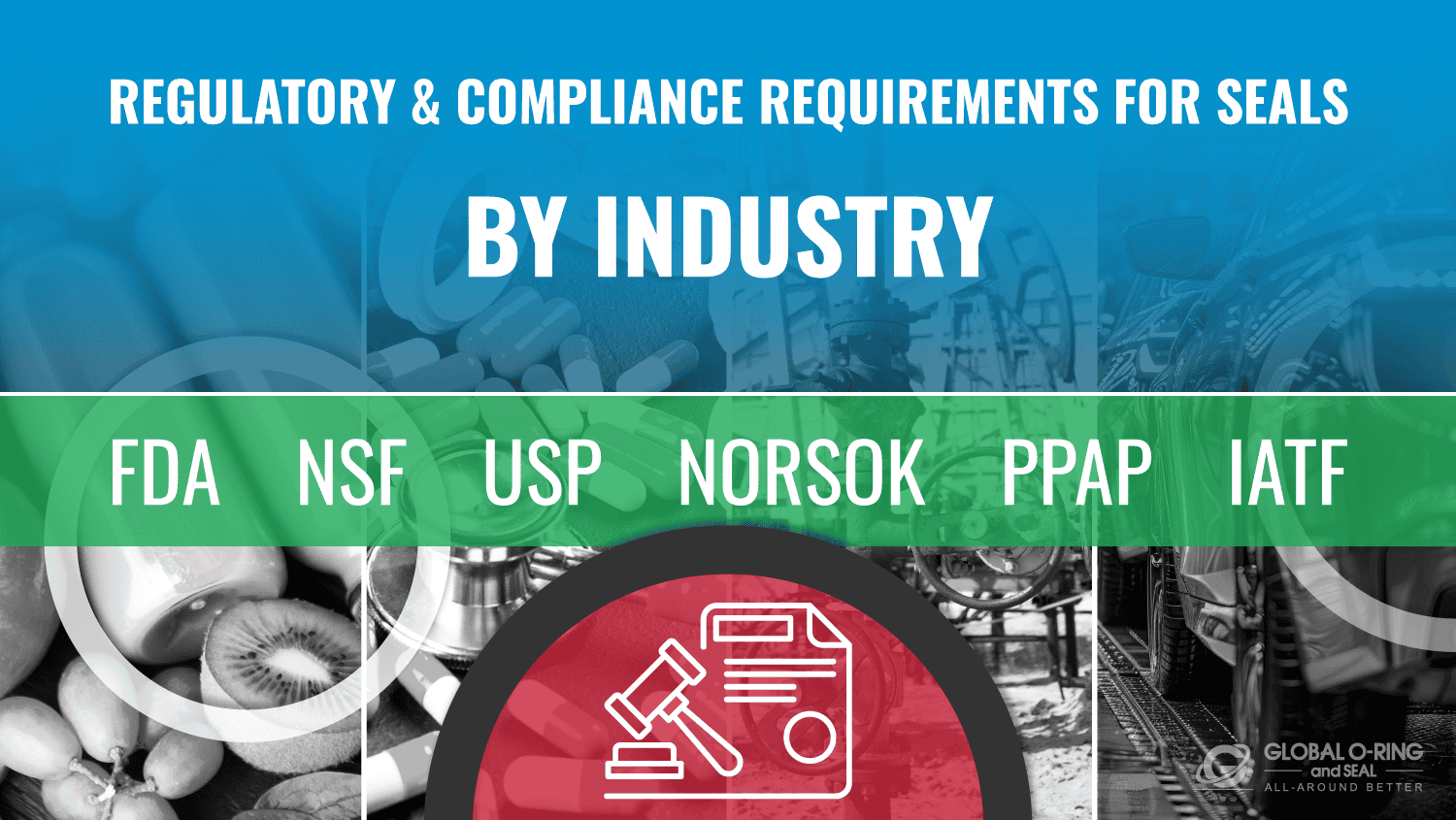
- Early identification of industry-specific sealing compliance requirements helps engineers select certified o-rings during design, reducing validation risk, avoiding redesigns, and accelerating global regulatory approval timelines.
- Food, medical, oil and gas, and automotive applications impose distinct standards such as FDA, NSF, USP, NORSOK, PPAP, and IATF that directly influence seal qualification.
- Industry-specific compliance summaries and a centralized glossary provide OEM engineers with a practical reference for navigating certifications, documentation requirements, and validation pathways across regulated sealing applications.
Introduction
Designing reliable sealing solutions requires careful consideration of industry regulations and standards. Many industries require seals to meet specific certifications or standards. By understanding these requirements early in the design phase, engineers can select the appropriate o-rings and elastomer materials certified for their application, avoiding costly redesigns or regulatory issues later.
Food, Beverage & Water: FDA and Sanitary Compliance for Sealing Applications
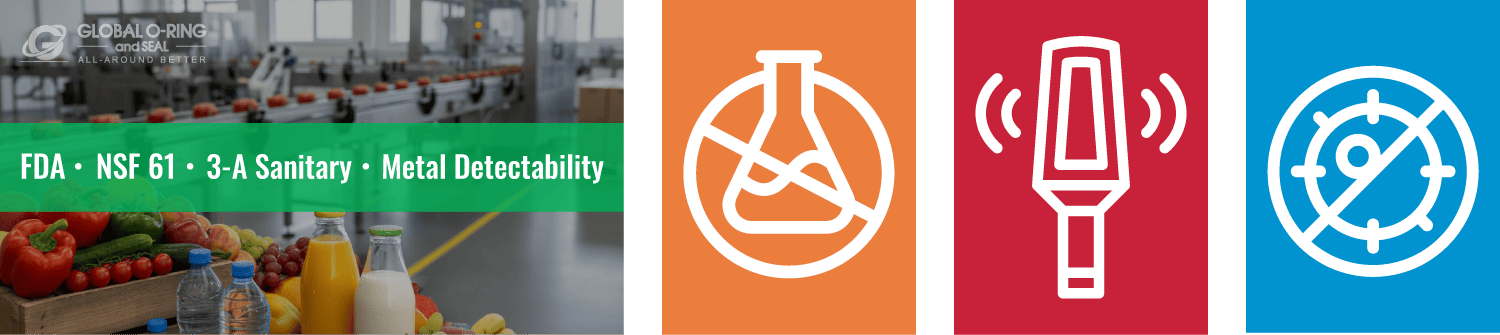
Food and potable water applications demand non-toxic, contaminant-free sealing materials. The U.S. Food & Drug Administration (FDA) sets the baseline for food-grade elastomers. An FDA-Compliant O-Ring is made from ingredients listed in the FDA’s regulations (21 CFR 177.2600) and must pass extraction tests to ensure it doesn’t leach harmful substances. Manufacturers self-certify compliance by issuing FDA Declarations of Compliance, since the FDA itself doesn’t “certify” individual o-rings. Regular re-testing is crucial, as regulations and formulations can evolve.
Beyond the FDA, the NSF/ANSI Standard 61 is critical for drinking water applications. NSF 61 certification ensures that a seal will not leach unsafe levels of any substance into potable water. O-Rings with NSF 61 certification have been independently lab-tested and confirmed free of NSF’s list of forbidden contaminants.
In food and dairy processing, 3-A Sanitary Standards may apply. The U.S. dairy industry established these to ensure equipment is thoroughly cleaned and won’t harbor bacteria. Elastomers must be approved for direct dairy contact and for exposure to harsh clean-in-place (CIP) sanitizers to be 3-A compliant. Notably, 3-A compliant seals also meet FDA food-grade criteria.
Food and beverage production facilities also often employ Metal-Detectable O-Rings as a best practice. These seals contain dispersed metal or X-ray-visible particles so that if a piece of seal shears off into the product, it can be detected and removed. This level of safety supports compliance with quality programs and regulations that prevent contamination by foreign material.
Key Compliance Requirements
- FDA Compliance (21 CFR 177.2600): Seals must be manufactured from FDA-listed ingredients and pass extraction limits for water and n-hexane to prevent harmful leachables in food or pharmaceutical contact.
- NSF/ANSI 61 Certification (Potable Water): Required for seals used in drinking water systems to ensure no unsafe substances migrate into potable water under long-term service conditions.
- 3-A Sanitary Standards (Food & Dairy Processing): Applies to seals used in dairy and sanitary food equipment; materials must withstand repeated clean-in-place (CIP) cycles while remaining safe for direct product contact.
- Metal Detectability (Risk Mitigation Best Practice): Enables rapid detection and removal of seal fragments in the event of failure, supporting HACCP programs and foreign material contamination controls.
Medical & Pharmaceutical: Medical-Grade Sealing and Cleanroom Manufacturing
The medical and pharma sectors impose some of the strictest requirements on sealing materials. Biocompatibility is paramount, as materials must not cause adverse reactions in the body or contaminate high-purity drugs. A standard benchmark is USP Class VI certification, which indicates that the elastomer has passed rigorous biological reactivity tests. In practice, USP Class VI O-Rings have proven they’re safe for use in medical devices, pharmaceutical production, or biotech equipment where they may contact drug formulations or bodily fluids.
Manufacturing conditions are also tightly controlled. Cleanroom-Produced O-Rings are often required to meet the high sanitation and sterility standards of medical and pharma applications. Cleanrooms are classified by ISO 14644 based on allowed particle counts. Many medical device and pharmaceutical companies stipulate that elastomeric seals be manufactured and packaged in a cleanroom at least Class 1,000 (ISO 6).
Medical/pharma seals often must be FDA-compliant if they come into contact with ingestible products or pharmaceuticals. Many pharmaceutical processing o-rings use compounds compliant with 21 CFR 177.2600. Some applications may require ISO 10993 series testing for biocompatibility beyond USP Class VI, depending on the duration and nature of body contact.
Key Compliance Requirements
- USP Class VI & ISO 10993 Biocompatibility: Seals must pass biological reactivity testing to ensure they do not cause toxicity, irritation, or contamination when in contact with drugs, bodily fluids, or medical devices.
- Cleanroom Manufacturing (ISO 14644): Required for many medical and pharmaceutical applications to control particulate contamination; seals are commonly manufactured and packaged in ISO Class 6 (Class 1,000) or cleaner environments.
- FDA Compliance (21 CFR 177.2600): Applies to seals used in pharmaceutical processing or applications involving ingestible or injectable products to prevent harmful extractables and leachables.
- Application-Specific Validation: Some medical uses require additional biocompatibility testing based on duration and type of contact (short-term, long-term, or implantable), beyond baseline USP Class VI requirements.
Oil & Gas: High-Pressure and Hazardous Service Requirements for Seals
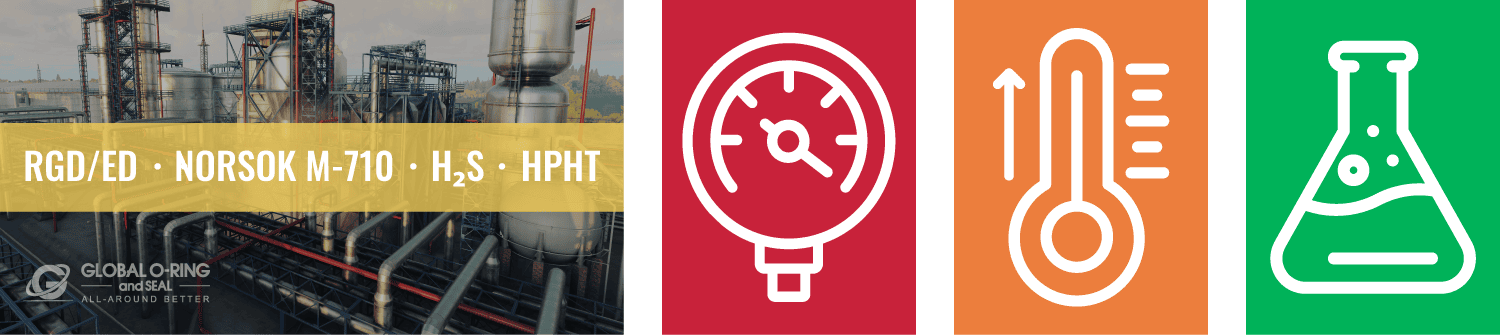
Seals used in oilfield and energy applications contend with extreme pressures, temperatures, and chemically aggressive environments. A critical failure mode in these conditions is Rapid Gas Decompression (RGD), also known as Explosive Decompression (ED). RGD occurs when equipment under high-pressure gas is depressurized very quickly, potentially rupturing the seal. To prevent this, the oil & gas industry demands RGD-resistant o-rings for many applications.
There are well-recognized standards for RGD resistance. Notably, the NORSOK M-710 standard defines a rigorous test for explosive decompression behavior in o-rings. O-Rings that pass NORSOK M-710 ED tests have demonstrated they can survive specified high-pressure gas exposure and rapid decompression with minimal damage.
Other regulatory considerations in oil & gas include resistance to sour gas. Materials may need to withstand exposure to H₂S (hydrogen sulfide) per standards like NACE TM0187 or ISO 23936. Fire safety is another concern.
Finally, oil & gas seals often must endure wide temperature extremes (high-pressure, high-temperature conditions). Materials are selected to meet those environmental specs rather than a specific regulatory code. However, the industry’s focus on quality management and documentation is high. Suppliers are typically ISO 9001 certified and must provide material test reports.
Key Compliance Requirements
- Explosive Decompression (RGD/ED) Resistance: Required for seals exposed to high-pressure gas service; o-rings must be qualified to withstand rapid depressurization without cracking, blistering, or internal damage.
- NORSOK M-710 Qualification: A widely accepted benchmark for validating explosive decompression performance through controlled high-pressure gas exposure and rapid decompression testing.
- Sour Gas Compatibility: Seals used in sour service must meet applicable NACE or ISO requirements to resist chemical degradation and embrittlement in hydrogen sulfide environments.
- High-Pressure, High-Temperature Capability: Seals must withstand extreme operating temperatures and pressures typical of upstream and midstream oil & gas systems.
- Quality Documentation & Traceability: Compliance in safety-critical applications requires Material certifications, batch traceability, and controlled manufacturing processes (ISO 9001 or equivalent).
Automotive: Quality and Compliance Standards for Sealing Components
The automotive industry’s compliance focus is heavily on quality systems and consistent performance. Automakers require suppliers to adhere to the IATF 16949 automotive quality management standard, which emphasizes defect prevention, process consistency, and continuous improvement. Design engineers should thus source o-rings from suppliers certified to IATF 16949 or ISO 9001, as this is often a prerequisite in the automotive supply chain.
When it comes to the parts themselves, a critical process is the Production Part Approval Process (PPAP). The Automotive Industry Action Group (AIAG) mandates PPAP to confirm a supplier can mass-produce parts that consistently meet the design tolerances and quality requirements. A PPAP-approved seal means that the supplier has provided a complete documentation package (including material data, process capability stats, control plans, etc.) and initial sample parts that the OEM has approved. PPAP ensures that o-rings will be manufactured under controlled conditions with minimal variability. Design engineers should involve suppliers early to obtain PPAP documentation for any new seal design intended for vehicle production.
Automotive applications also often entail meeting material performance standards. Many OEMs have their own material specifications for rubber parts. Some of these requirements mirror external standards. UL 157 is sometimes referenced for under-hood or fuel system seals to ensure they meet specific heat and fluid resistance categories. While UL listing is more commonly associated with electrical components, having UL-Certified O-Ring compounds can simplify demonstrating fuel/fluid compatibility and safety in automotive designs.
Another consideration is environmental and safety compliance for materials. Automakers worldwide must comply with regulations on hazardous substances. Seals should be RoHS and REACH compliant, meaning they contain no banned heavy metals or chemicals above threshold levels. Additionally, manufacturers track substances in accordance with the global automotive declarable substance lists.
Key Compliance Requirements
- Automotive Quality Management (IATF 16949): Seal suppliers must operate under automotive-certified quality systems to ensure consistent production, defect prevention, and traceability throughout the supply chain.
- Production Part Approval Process (PPAP): Required for production-bound seals; validates that o-rings can be manufactured repeatedly within tolerance using controlled processes supported by full documentation and sample approval.
- UL 157 Recognition (Application-Dependent): May be required for seals used in fuel, under-hood, or safety-critical environments to demonstrate verified heat and fluid resistance performance.
- Environmental & Chemical Compliance: Materials must be RoHS and REACH-compliant and reportable through global automotive substance-tracking systems to meet regulatory and sustainability requirements.
Glossary of Sealing Compliance Standards & Certifications
By understanding and applying the standards and certifications outlined below, engineers can design sealing solutions that meet all regulatory compliance requirements for their industry. Selecting the right certified o-ring from the start reduces risk, speeds up product approvals, and ultimately leads to safer, more reliable equipment across all sectors of industry.
FDA-Compliant (21 CFR 177.2600)
Refers to elastomeric materials formulated from FDA-approved ingredients and validated through extraction testing in water and n-hexane to ensure they do not leach harmful substances into food, drugs, or pharmaceuticals. The manufacturer self-certifies compliance with FDA requirements through a Declaration of Compliance.
NSF/ANSI 61
A third-party certification for components used in drinking water systems. NSF 61 ensures that seals do not release contaminants into potable water above established health-based limits during long-term service.
3-A Sanitary Standards
Sanitary design standards developed for dairy and food-processing equipment. 3-A Standard 18-03 applies to multi-use rubber materials and confirms seals are safe for direct food contact, resistant to clean-in-place (CIP) chemicals, and suitable for hygienic system design.
USP Class VI
A biocompatibility classification indicating an elastomer has passed United States Pharmacopeia Class VI biological reactivity testing. This includes systemic toxicity, intracutaneous, and implantation testing, demonstrating suitability for medical devices, pharmaceutical processing, and biotech applications.
ISO 10993
A series of international standards used to evaluate the biological safety of materials in medical applications. ISO 10993 testing may be required in addition to USP Class VI, depending on the type, duration, and nature of human contact.
Cleanroom Classification
Defines cleanroom environments based on allowable airborne particle counts. Cleanroom manufacturing reduces particulate and microbial contamination on seals used in medical, pharmaceutical, and high-purity applications.
- ISO Class 8 (Class 100,000): General controlled manufacturing
- ISO Class 6 (Class 1,000): Common for medical and pharmaceutical sealing
- ISO Class 5 (Class 100): High-purity and semiconductor environments
Cleanroom-produced o-rings are manufactured and packaged under these controlled conditions.
UL 157
Underwriters Laboratories standard for elastomeric o-rings and gaskets used in UL-certified equipment. UL 157 evaluates mechanical properties, thermal stability, compression set, and fluid resistance. UL-recognized compounds are assigned end-use codes indicating approved applications such as fuel, oil, or gas exposure.
IATF 16949
An automotive-specific quality management system standard that builds upon ISO 9001. IATF 16949 certification confirms a supplier’s ability to support defect prevention, process consistency, traceability, and continuous improvement in automotive production environments.
PPAP (Production Part Approval Process)
A validation framework used in the automotive industry to confirm that a component can be manufactured consistently within specification. PPAP documentation typically includes material data, control plans, process capability studies, FMEAs, and approved production samples.
NORSOK M-710
A petroleum industry standard that includes test methods for rapid gas decompression (explosive decompression) resistance in elastomers. O-Rings passing NORSOK M-710 have demonstrated the ability to withstand high-pressure gas exposure followed by rapid depressurization without cracking or blistering.
API 6A & API 6D
API specifications governing wellhead, valve, and pressure-control equipment in oil & gas applications. These standards include performance and validation requirements for non-metallic seals operating under high pressure, high temperature, and chemically aggressive conditions.
RoHS (Restriction of Hazardous Substances)
A global environmental directive limiting the use of specific hazardous substances, including lead, mercury, cadmium, hexavalent chromium, and certain flame retardants. RoHS-compliant seals meet these restrictions and are suitable for regulated international markets.
REACH
An EU regulation governing the registration and restriction of chemical substances. REACH-compliant seals do not contain Substances of Very High Concern (SVHCs) above allowable thresholds, supporting environmental safety and global regulatory compliance.