 Italiano
  English
  Español
  Français
  Português
  Deutsch
  Русский
  中文
中文  日本語
日本語  العربية
  हिन्दी

Summary
- Viton® (FKM) o-rings withstand continuous temperatures up to 450°F (232°C) and resist oils, fuels, mineral acids, and aggressive hydrocarbons — outperforming most elastomers in harsh service conditions.
- Specialty grades — Viton® A, B, F, GLT, GFLT, ETP, and RGD — address specific challenges including low-temperature flexibility, sour gas exposure, and rapid gas decompression.
- Viton® o-rings are critical sealing components in aerospace, automotive, oil and gas, food processing, and pharmaceutical applications, with grades available to meet FDA, ASTM, and SAE compliance requirements.
What Are Viton® O-Rings?
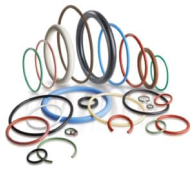
Viton® (FKM) o-rings are fluoropolymer elastomer seals engineered for extreme service conditions where standard rubber compounds fail. Developed in the late 1950s by DuPont, Viton® is a registered brand name for FKM — fluoroelastomer — a synthetic rubber defined by its high fluorine content.
That fluorine content is the source of Viton®’s performance advantage. The carbon-fluorine bond is one of the strongest in organic chemistry, giving FKM seals exceptional resistance to heat, aggressive chemicals, and environmental degradation. In industrial settings, Viton® o-rings are specified wherever seal failure carries real operational or safety consequences.
Key Properties of Viton® FKM O-Rings
Temperature Resistance
Viton® o-rings operate continuously from -15°F (-26°C) to 450°F (232°C), with specialty low-temperature grades extending the cold-side limit to -40°F (-40°C). This range far exceeds nitrile and EPDM, making Viton® the default choice for high-heat environments including combustion engines, exhaust systems, and industrial ovens.
Chemical Resistance
Viton® o-rings resist oils, fuels, lubricants, hydraulic fluids, and most mineral acids. Their chemical compatibility is broad, but the specific grade selected affects performance against particular media — especially oxygenated fuels, sour gas, and strong bases. When in doubt, consult a compatibility chart or request a compound data sheet.
Aging, Weathering, and Ozone Resistance
Unlike nitrile or neoprene, Viton® resists ozone cracking, UV degradation, and oxidation. Seals retain their elasticity and dimensional stability over long service intervals, reducing replacement frequency and associated downtime costs.
Low Gas Permeability
Viton®’s low permeability to gases makes it the preferred o-ring material for vacuum systems, pressurized gas lines, and applications where seal integrity must prevent even trace leakage.
Compression Set Resistance
Under sustained compression, Viton® o-rings resist permanent deformation — a property called compression set resistance. This allows the seal to recover its original cross-section after load cycles, maintaining sealing force over time. It is a critical attribute in both static and dynamic applications.
Viton® O-Ring Performance in Extreme Conditions
The fluoropolymer backbone of Viton® provides mechanical advantages beyond chemical inertness. The material’s high modulus and shear resistance allow it to hold shape under significant pressure differentials, while its elasticity enables effective sealing under vacuum. This dual performance — pressure and vacuum — is essential in aerospace and subsea applications where cycling between conditions is routine.
In the oil and gas sector, Viton®’s carbon-fluorine bonds resist breakdown from hydrocarbons, aromatics, and sour gas (H₂S-containing environments). This chemical stability directly translates to extended seal life in downhole and surface equipment where elastomer degradation accelerates failure and increases workover costs.
For dynamic sealing applications — rotating shafts, reciprocating pistons, valve stems — Viton®’s resilience under mechanical stress ensures consistent contact force and reduced leakage paths, even after thousands of cycles.
Viton® Grades: Choosing the Right Formulation
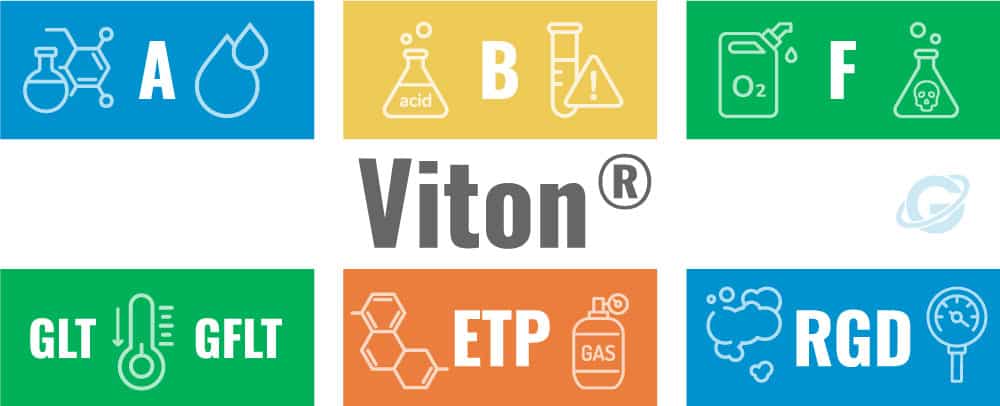
Not all Viton® is the same. Each grade is formulated to optimize specific properties, and selecting the wrong grade for an application is one of the most common causes of premature seal failure.
Viton® A — The standard-grade FKM. Broad chemical resistance and excellent performance in oils and fuels. The baseline specification for most general industrial applications.
Viton® B — Higher fluorine content than Grade A, providing enhanced resistance to acids and caustic fluids. The preferred choice in chemical processing where Grade A falls short.
Viton® F — Formulated for resistance to oxygenated fuels (ethanol blends, methanol) and aggressive acids including nitric and phosphoric. Required in fuel systems handling alternative or blended fuels.
Viton® GLT — Low-temperature grade retaining flexibility and sealing performance down to -40°F (-40°C). Specified for cold-climate operations, refrigerated processes, and cryogenic-adjacent applications.
Viton® GFLT — Combines low-temperature capability with the higher chemical resistance of Grade F. Used where both cold flexibility and broad chemical compatibility are required.
Viton® ETP (Extreme) — The highest-performance Viton® grade, engineered for sour gas, aggressive hydrocarbons, and chemical environments that degrade standard FKM. Widely used in upstream oil and gas exploration and production.
RGD-Resistant Viton® — Formulated to resist rapid gas decompression (RGD), the physical damage that occurs when seals are exposed to high-pressure gas and then rapidly depressurized. Essential for wellhead equipment, gas injection systems, and high-pressure valves.
Regulatory compliance drives grade selection in food, pharmaceutical, and medical applications. FDA-compliant Viton® grades are formulated to meet 21 CFR requirements. Automotive and aerospace applications typically require ASTM D2000 or SAE specifications. Always verify compliance documentation before specifying a grade for regulated processes.
Industrial Applications of Viton® O-Rings

Aerospace and Aviation
Aircraft fuel systems, hydraulic lines, and engine assemblies demand seals that perform across the full range of flight conditions — from cold soak on the ground to high heat and pressure at altitude. Viton® o-rings are specified throughout these systems for their thermal range and resistance to aviation fuels, hydraulic fluids, and lubricants.
Automotive
The automotive industry uses Viton® o-rings extensively in fuel injection systems, fuel pumps, and emissions components. Their resistance to gasoline, diesel, biodiesel blends, and high underhood temperatures makes them the standard seal material in fuel handling systems where nitrile would degrade prematurely.
Oil and Gas
In upstream and midstream oil and gas, seals face sour gas, high pressures, elevated temperatures, and rapid pressure cycling. Viton® ETP and RGD-resistant grades are specified for downhole tools, wellhead equipment, and pipeline components where seal failure has significant safety and production consequences.
Food Processing and Pharmaceuticals
Food and beverage processing and pharmaceutical manufacturing require sealing materials that are inert, cleanable, and compliant with FDA regulations. FDA-grade Viton® o-rings do not contaminate products and withstand steam, cleaning agents, and the temperature cycling common in CIP/SIP processes.
Viton® O-Ring Selection Guide
Selecting the correct Viton® o-ring requires evaluating five variables:
1. Chemical compatibility — Identify all media the seal will contact, including cleaning agents and incidental fluids. Cross-reference against Viton® compatibility data, and select the grade that resists the most aggressive substance in the system.
2. Temperature range — Confirm both the continuous service temperature and peak transient temperatures. Standard Viton® grades handle up to 450°F; GLT and GFLT grades are required for cold-side service below -15°F.
3. Pressure conditions — The o-ring must resist extrusion at maximum system pressure. Dynamic sealing applications — where the seal moves or the mating surface moves against it — generally require higher tensile strength and may require a backup ring at higher pressures.
4. Durometer — Harder compounds (higher Shore A) resist extrusion and wear but reduce flexibility. Softer compounds seal at lower contact forces but are more susceptible to extrusion in high-pressure applications. Most standard Viton® o-rings are supplied at 75 Shore A; 90 Shore A is available for high-pressure service.
5. Sizing — The o-ring cross-section must fill the gland adequately to maintain contact force without over-compression. Use standard groove design guidelines for static and dynamic applications; both inside diameter and cross-section tolerance affect sealing performance.
The Future of Viton® and Fluoroelastomer Sealing
Material science advances continue to extend Viton®’s performance ceiling. Current development directions include higher thermal limits through modified fluorine content ratios, improved low-temperature flexibility without sacrificing chemical resistance, and enhanced resistance to newer alternative fuels and process chemicals.
Sustainability is an increasing factor: fluoroelastomer producers are developing production processes with reduced environmental impact, and longer seal service life directly reduces the material consumption and waste associated with seal replacement programs.
As industrial processes push into higher temperatures, more aggressive chemistries, and more demanding pressure cycles, Viton® FKM o-rings will continue to be the baseline specification where performance cannot be compromised.