O-Ring Materials, Applications, and Selection
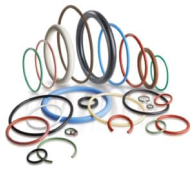
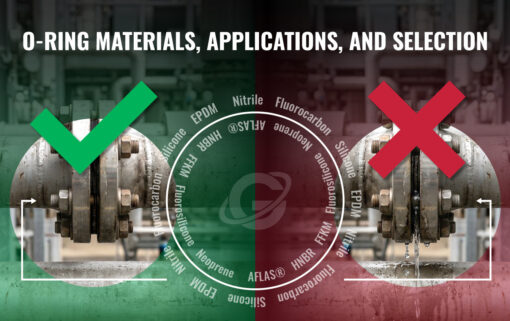
Summary Introduction An o-ring is an elastomeric ring with a round cross-section that forms a seal by squeezing and applying pressure. That sealing mechanism depends on the elastomer returning toward its original shape after deformation (elastic recovery) and maintaining contact pressure against the gland surfaces over time. Because elastomers respond differently to heat, cold, fluids, […]
Thermal Aging vs Chemical Attack: Diagnosing Elastomer Seal Failures
Summary Thermal Aging vs. Chemical Attack in Elastomer Seals Elastomer seals fail for many reasons, but thermal aging and chemical attack are among the most common. Thermal aging degrades elastomers over time by altering the polymer’s internal structure and physical properties, while chemical attack damages seals through material incompatibility, leading to swelling, shrinkage, or loss […]
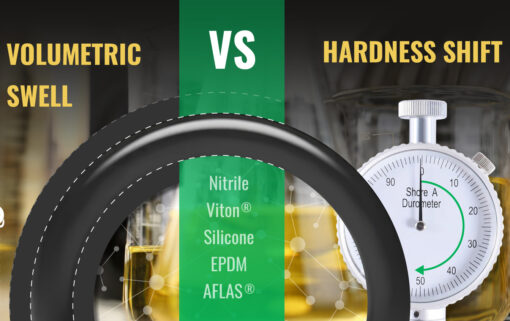
Volumetric Swell vs. Hardness Shift in Elastomers
Summary Why Swell and Hardness Matter in Seal Performance When an elastomer seal is exposed to fluids over time, two material-level changes largely determine its long-term reliability: volumetric swell and hardness shift. These parameters capture how the seal’s size and stiffness evolve due to chemical exposure. Excessive swell or a significant change in hardness can […]
O-Ring Failures: Identify, Prevent, Overcome
Summary Introduction O-rings are among the most widely used sealing solutions for industrial applications. These components help prevent fluid or gas leakage, ensuring the efficiency and safety of countless mechanical systems. Despite their durability, o-rings are not immune to failure. Factors such as improper material selection, extreme environmental conditions, poor installation practices, and prolonged wear […]
Understanding ISO 3601-3 Standards
Summary Introduction to ISO 3601 Standards The ISO 3601 series is a comprehensive set of standards that define specifications for o-ring sizes, tolerances, surface imperfections, and quality grades. These specifications guarantee that seals meet rigorous performance and compatibility requirements. By providing a globally recognized framework, ISO 3601 simplifies the selection, production, and application of o-rings […]
Dilatation thermique et performances d'étanchéité
Résumé Introduction à la dilatation thermique La dilatation thermique fait référence à la façon dont les matériaux se dilatent lorsqu’ils sont exposés à une augmentation de température. Lorsque les joints subissent des changements dimensionnels dus aux fluctuations de température, des problèmes tels que des fuites, une extrusion ou une défaillance peuvent survenir, ce qui fait de la dilatation thermique une considération essentielle lors du choix des matériaux et de la conception des joints. Comprendre comment la dilatation thermique affecte les joints […]
Français
English
Español
Português
Deutsch
Italiano
Русский
中文
日本語
العربية
हिन्दी