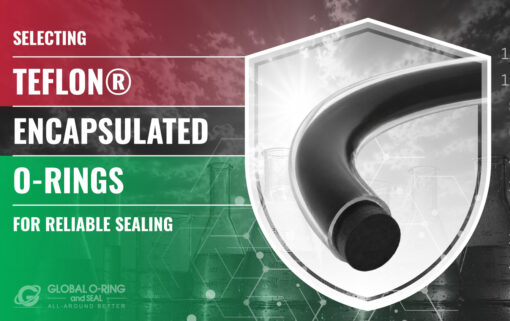
Selecting Teflon® Encapsulated O-Rings for Reliable Sealing
Summary Introduction Teflon® encapsulated o-rings provide reliable sealing in environments where chemical exposure, temperature variation, or cleanliness requirements challenge standard elastomer materials. By combining a chemically resistant fluoropolymer jacket with a resilient elastomer core, these seals offer a practical solution when compatibility and long-term stability are critical to system performance. What Are Teflon® Encapsulated O-Rings? […]
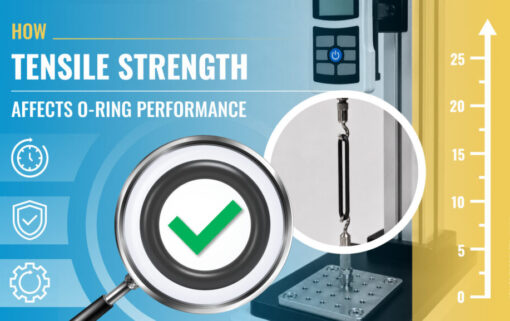
How Tensile Strength Affects O-Ring Performance
Summary Introduction Tensile strength is a fundamental mechanical property that influences how elastomers respond to stress, deformation, and repeated loading. In sealing applications, this property helps determine whether an o-ring can withstand the mechanical demands encountered during installation and service. While tensile strength is often listed as a single value on a material datasheet, its […]
O-Ring Groove Design Calculator: Engineering the Right Gland Geometry the First Time
Correct O-ring groove design is a multi-variable problem with tighter tolerances than most engineers initially expect. Squeeze, gland fill, extrusion resistance, and tolerance stack-up all interact — and an error in any one of them can produce leakage, premature elastomer degradation, or catastrophic seal extrusion. Global O-Ring’s O-Ring Groove Design Calculator encodes the published design […]
How O-Rings Ensure Reliable Connector Sealing
Summary The Role of O-Rings in Connector Sealing Systems In many applications, connectors serve as sealing interfaces that must protect the connection from external exposure while maintaining system integrity. O-Rings serve as the sealing element, helping connectors resist leakage and contaminant ingress. When integrated into the connector design, they create a barrier that helps protect […]
English
Español
Français
Português
Deutsch
Italiano
Русский
中文
日本語
العربية
हिन्दी