 Deutsch
  English
  Español
  Français
  Português
  Italiano
  Русский
  中文
中文  日本語
日本語  العربية
  हिन्दी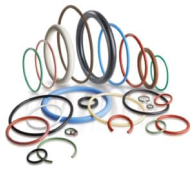





Flight-critical sealing for fuel, hydraulic, pneumatic, and high-temperature engine systems. We supply aerospace-grade elastomer o-rings and seals — fluorosilicone for jet fuel, EPDM for phosphate-ester (Skydrol) hydraulics, FKM and FFKM for high-temperature service — in AS568 and NAS1611 sizes, with domestic manufacturing available for defense and supply-chain-sensitive programs.
Aerospace sealing is a materials problem before it is a sizing problem. The same AS568 dash number can succeed or fail depending entirely on the compound: jet fuel, phosphate-ester hydraulic fluid, ozone, and a service window that can swing from −65°F at altitude to well over +400°F near an engine all demand different elastomers. This page maps aerospace systems and fluids to the right seal material, lists the standards we build to, and explains the domestic-sourcing options that matter for defense and supply-chain-sensitive programs. If you already have a print or spec, send it to us for a quote.
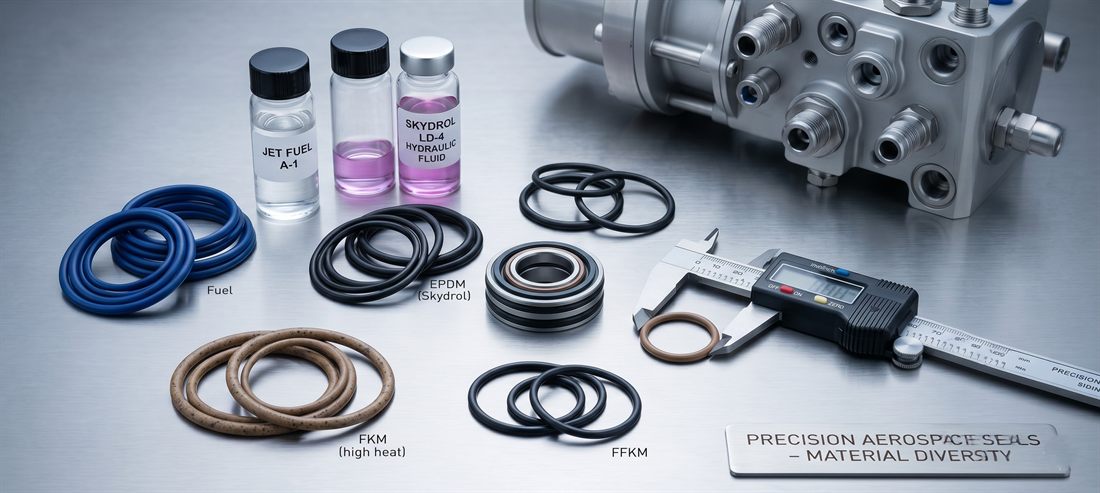
Start with the system and the fluid or environment the seal contacts, then choose the compound. The most common aerospace sealing failures come from putting a fuel-rated compound in a Skydrol line, or a standard nitrile in a high-temperature engine location.
Three questions: what system, what fluid or environment contacts the seal, and what compound handles it across the temperature range.
| System / application | Fluid or environment | Recommended compound | Material |
|---|---|---|---|
| Fuel systems (Jet A, JP-4, JP-5, JP-8) | Hydrocarbon jet fuel + wide temperature range | Fluorosilicone (FVMQ) | FVMQ → |
| Hydraulic systems — commercial aircraft | Phosphate-ester fluid (Skydrol, Hyjet) | EPDM | EPDM → |
| Hydraulic systems — petroleum-based | MIL-PRF-5606 / -83282 / -87257 fluids | Nitrile (NBR) or FKM | NBR → |
| Engine & turbine hot section | High temperature, fuel, synthetic lubricants | FKM or FFKM | FKM → |
| Extreme temperature / aggressive media | Continuous high heat + chemical attack | FFKM (perfluoroelastomer) | FFKM → |
| Environmental control / pneumatic / static | Wide temperature, air, ozone, weathering | Silicone (VMQ) | VMQ → |
| High-temp static / backup rings / anti-extrusion | Chemically inert, low friction, high temp | PTFE | PTFE → |
Critical rule: phosphate-ester hydraulic fluids (Skydrol, Hyjet) attack nitrile and fluorocarbon. Commercial aircraft hydraulic seals running these fluids must be EPDM. Confirm your hydraulic fluid spec before selecting a compound.
Fluorosilicone is the aerospace fuel-system workhorse. It combines the fuel and oil resistance of fluorocarbon with the extreme low-temperature flexibility of silicone — a combination almost no other elastomer offers. That makes it the default choice wherever a seal sees jet fuel and high-altitude cold.
Commercial aircraft hydraulic systems run phosphate-ester fluids (commonly known by the trade names Skydrol and Hyjet) for fire resistance. These fluids chemically attack nitrile and fluorocarbon. EPDM is the required elastomer family — it is essentially inert in phosphate esters and holds up across the hydraulic temperature range.
For high-temperature locations — engine accessories, turbine areas, hot fuel, and synthetic lubricant contact — fluorocarbon (FKM) and perfluoroelastomer (FFKM) are the aerospace high-heat materials. FKM covers the broad high-temp range economically; FFKM is reserved for the most extreme combination of heat and chemical attack, where its near-universal chemical resistance and continuous service above +500°F earns the premium.
Quick reference for aerospace elastomer selection. Service ranges are typical and compound-dependent — confirm against your program specification.
| Material | Typical temp range | Best for | Avoid in |
|---|---|---|---|
| FVMQ (fluorosilicone) | −75°F to +350°F | Jet fuel + cold; fuel system seals | High-pressure dynamic duty |
| EPDM | −65°F to +300°F | Phosphate-ester (Skydrol) hydraulics | Petroleum oils & fuels |
| FKM (fluorocarbon) | −15°F to +400°F | High-temp fuel & oil; engine areas | Skydrol; extreme cold (std grades) |
| FFKM | up to +600°F | Extreme heat + chemical attack | Cost-sensitive standard duty |
| NBR (nitrile) | −40°F to +250°F | Petroleum hydraulic fluid & fuel | Skydrol; ozone; high heat |
| VMQ (silicone) | −75°F to +400°F | Static seals, ECS, ozone/weathering | Fuel; dynamic / abrasion duty |
| PTFE | −100°F to +450°F | Backup rings, inert static seals | Applications needing elastic recovery |
Aerospace and space programs often specify sealing performance beyond a basic fluid-and-temperature rating. These are the engineered attributes to call out on an RFQ when the application demands them — specify the requirement and we’ll match the compound and grade.
In high-pressure gas systems, dissolved gas can rupture a seal from the inside when pressure drops quickly. High-modulus 90-durometer FFKM and specially compounded FKM grades are formulated to resist rapid gas decompression (RGD), also called explosive decompression (ED). Specify RGD resistance for high-pressure pneumatic, bleed-air, and gas-charged applications. More on rapid gas decompression →
For space, satellite, and vacuum service, materials are screened for outgassing per NASA ASTM E595 (TML ≤ 1.0%, CVCM ≤ 0.10%). Low-outgassing, cleanroom-handled FFKM and silicone grades maintain vacuum leak-tightness and avoid contaminating optics and sensitive surfaces.
Launch-vehicle and propulsion systems demand cryogenic sealing for liquid oxygen (LOX), liquid nitrogen, and liquid hydrogen, plus oxygen compatibility for gaseous O₂ systems. Material selection and cleaning (oxygen-clean processing) are both critical here — call out the media and cleanliness level on the RFQ.
Specialty FFKM grades resist plasma and reactive-gas attack (shared with semiconductor process sealing) and survive repeated thermal cycling with low compression set, so the seal recovers and keeps sealing across thousands of cycles.
RGD, low-outgassing, cryogenic, and plasma-resistant compounds to spec.
Aerospace seals are specified against a layered set of size, material, and quality standards. We supply to standard size systems and work from your AMS, MIL, MS, or NAS callouts.
Working to a specific AMS/MIL/NAS callout or a controlled drawing? Send the spec with your RFQ and we’ll quote to it.
Aerospace and defense procurement requires documented quality and supply-chain compliance. Our credentials and capabilities include:
Need specific quality documentation with your order? Note it on your RFQ.
Aerospace and defense programs increasingly carry domestic-content and supply-chain-traceability requirements — Buy American, DFARS, and program-specific sourcing rules. We are a US-based supplier and offer domestic manufacturing on request for o-rings and seals where the program requires it, alongside our standard inventory for prototyping and lower-criticality applications.
For custom geometries, non-standard sizes, and program-specific compounds, our custom molded o-ring program produces to your drawing. Defense and military programs — including MIL-spec o-ring requirements — are covered on our defense & military seals page.
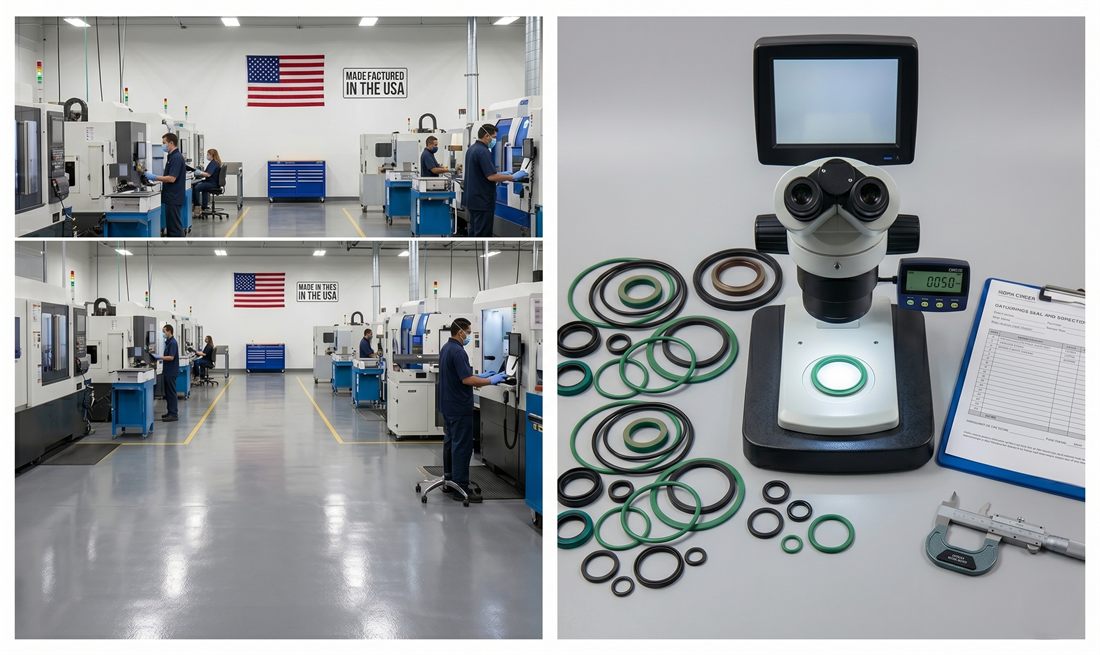
AS9100 / ISO 9001 quality system, ITAR registered, NADCAP accredited.
Domestic manufacturing available; DFARS and Buy American capable.
FVMQ, EPDM, FKM, FFKM, NBR, VMQ, and PTFE from one source.
AS568/NAS1611 stock plus custom molded geometries to drawing.
Fluorosilicone (FVMQ) is the standard o-ring material for aircraft fuel systems. It resists hydrocarbon jet fuels (Jet A, JP-4, JP-5, JP-8) while staying flexible at the very low temperatures encountered at altitude — roughly −75°F to +350°F. Fluorocarbon (FKM) is also used where the fuel runs hot but extreme cold is not a factor. Standard nitrile is generally not used in modern aircraft fuel systems because it cannot match the temperature range.
EPDM is the seal material compatible with Skydrol and other phosphate-ester aviation hydraulic fluids (such as Hyjet). Phosphate esters chemically attack nitrile (NBR) and fluorocarbon (FKM), causing them to swell and fail, so commercial aircraft hydraulic systems running these fluids use EPDM o-rings and seals. Note that EPDM must not be used in petroleum-based hydraulic systems, where the opposite is true and nitrile or fluorocarbon is required.
Fluorosilicone (FVMQ) is used in aerospace wherever a seal must resist fuel and oil while remaining flexible in extreme cold. It combines the fuel resistance of fluorocarbon with the low-temperature flexibility of silicone, which makes it the default material for aircraft fuel tank seals, fuel line fittings, and fuel pump seals. Typical specifications include AMS 7379 and MIL-DTL-25988.
Aerospace o-rings can see anywhere from about −65°F to −75°F at altitude up to +400°F or higher near engines and turbines, so the required range depends entirely on the location. Fluorosilicone covers the low end with fuel resistance; FKM covers high-temperature fuel and oil; FFKM extends continuous service to roughly +600°F; silicone offers the widest range for static, non-fuel applications. Always select the compound for the specific temperature window of the application.
Yes. We supply o-rings and seals to AS568 and NAS1611 size standards and work from AMS material specifications (such as AMS 7276 for FKM and AMS 7379 for fluorosilicone), MIL-DTL/MIL-PRF specifications, and MS part-number callouts. Send your specification or controlled drawing with a quote request and we will quote to it. Defense and military requirements are covered in more detail on our mil-spec o-rings page.
Yes. We are a US-based supplier and offer domestic manufacturing on request for o-rings and seals, which supports Buy American, DFARS, and program-specific domestic-content and supply-chain-traceability requirements common in aerospace and defense work. Standard inventory is available for prototyping and lower-criticality applications, and custom molded production is available to your drawing.
Use fluorocarbon (FKM) for most high-temperature aerospace engine and accessory seals — it handles roughly −15°F to +400°F with strong fuel and oil resistance and is compatible with synthetic turbine engine oils (MIL-PRF-23699, MIL-PRF-7808). Step up to perfluoroelastomer (FFKM) when the application combines extreme heat (up to about +600°F continuous) with aggressive chemical exposure. FFKM costs more but provides near-universal chemical resistance where FKM reaches its limit.
High-modulus FFKM grades, typically at 90 Shore A durometer, are formulated to resist rapid gas decompression (RGD), also called explosive decompression (ED). RGD occurs when gas dissolved into the elastomer under pressure expands and ruptures the seal as system pressure drops quickly. For high-pressure pneumatic, bleed-air, and gas-charged aerospace applications, specify an RGD-resistant high-modulus FFKM (or a specially compounded FKM) and we will match the grade to the pressure and cycle requirements.
Yes. For space, satellite, and vacuum service, materials are screened for outgassing per NASA ASTM E595, with typical acceptance limits of TML (total mass loss) ≤ 1.0% and CVCM (collected volatile condensable materials) ≤ 0.10%. Low-outgassing, cleanroom-handled FFKM and silicone grades maintain vacuum leak-tightness and avoid contaminating optics and sensitive surfaces. Cryogenic (LOX, liquid nitrogen, liquid hydrogen) and oxygen-compatible options are also available — specify the media and cleanliness level on your RFQ.
Send your AS568/NAS1611 size, material spec, or controlled drawing. We quote standard and custom aerospace o-rings and seals, with domestic manufacturing available on request.
Request a Quote →Not sure which compound fits your fluid and temperature window? Our team helps match the material to your application and specification.
Contact Us →Trade names referenced (e.g. Skydrol and Hyjet for phosphate-ester hydraulic fluids; Viton, the common name for fluorocarbon FKM) identify generic fluid and material chemistries. Trademarks are the property of their respective owners and are referenced for identification only. Temperature ranges and material recommendations on this page are general engineering guidance and are compound- and grade-dependent — verify against your program specification and controlled drawing before release.

Global O-Ring and Seal, LLC is a master distributor of O-Rings, Backup Rings, X-Rings, Cord Stock, and related seals, servicing industrial distributors worldwide. We stock all major compounds including Buna (Nitrile), Viton (FKM), EPDM, Silicone, Teflon, Aflas, etc. We carry a full range of AS568 standard sizes, as well as metric sizes and O-Ring cord stock.
Learn More