 English
  Español
  Français
  Português
  Deutsch
  Italiano
  Русский
  中文
中文  日本語
日本語  العربية
  हिन्दी
Summary
- O-Ring performance depends heavily on selecting an elastomer that matches the operating environment. Temperature, chemical exposure, pressure, and motion all influence whether a seal maintains elasticity and sealing force over time.
- Common materials such as nitrile (NBR), fluorocarbon (FKM), silicone (VMQ), and EPDM cover many industrial applications, while specialty elastomers like AFLAS, HNBR, FFKM, fluorosilicone, and neoprene address extreme chemical, thermal, or mechanical conditions.
- A structured material selection process, including evaluating temperature range, chemical compatibility, mechanical stresses, and regulatory requirements, helps prevent common failure modes and improve long-term sealing reliability.
Introduction
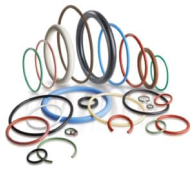
An o-ring is an elastomeric ring with a round cross-section that forms a seal by squeezing and applying pressure. That sealing mechanism depends on the elastomer returning toward its original shape after deformation (elastic recovery) and maintaining contact pressure against the gland surfaces over time.
Because elastomers respond differently to heat, cold, fluids, and mechanical stress, the o-ring material determines whether the seal stays resilient or fails early. Even a perfectly machined groove cannot compensate for an elastomer that swells in the fluid, hardens from heat, or permanently deforms under compression.
Understanding the differences between common o-ring materials and specialty elastomers used in more demanding environments allows engineers to match seal materials to operating conditions and improve long-term reliability.
Why O-Ring Material Selection Matters
O-Rings seal because the elastomer stores energy when compressed (“squeezed”) and pushes back against the surrounding metal surfaces. This sealing force depends on elasticity, which is the material’s ability to return to its original shape after deformation. If the elastomer cannot recover properly, the sealing force gradually decreases, increasing the likelihood of leakage.
Influences on Long-Term O-Ring Performance
Two material behaviors have the greatest influence on long-term o-ring performance: compression set resistance and chemical compatibility.
Compression set measures how much a rubber material fails to recover after being compressed for an extended period. A high compression set reduces the force the o-ring applies against sealing surfaces, particularly after heat aging or long dwell times under compression.
Chemical compatibility determines how an elastomer reacts when exposed to fluids. Elastomers may absorb the surrounding medium while simultaneously losing soluble ingredients such as plasticizers. These processes lead to volume change, either swelling or shrinkage. Swelling can increase friction, promote extrusion, or distort the seal geometry, while shrinkage reduces interference and sealing contact. Elevated temperatures often accelerate these effects because many fluids become more chemically aggressive as temperature rises.
Potential O-Ring Failures From Incorrect Material Selection
When o-ring material selection does not match the operating environment, failures often appear in predictable ways:
- Swelling or softening caused by incompatible oils, fuels, or solvents, reducing mechanical strength and dimensional stability
- Shrinkage after extraction of compound ingredients, reducing sealing contact
- Hardening or embrittlement from heat exposure or chemical reactions, lowering elasticity and sealing force
- Extrusion, where the elastomer flows into clearance gaps under pressure
- Explosive decompression (ED) damage caused by rapid pressure drops in gas service, producing internal blistering and structural damage
Common O-Ring Materials
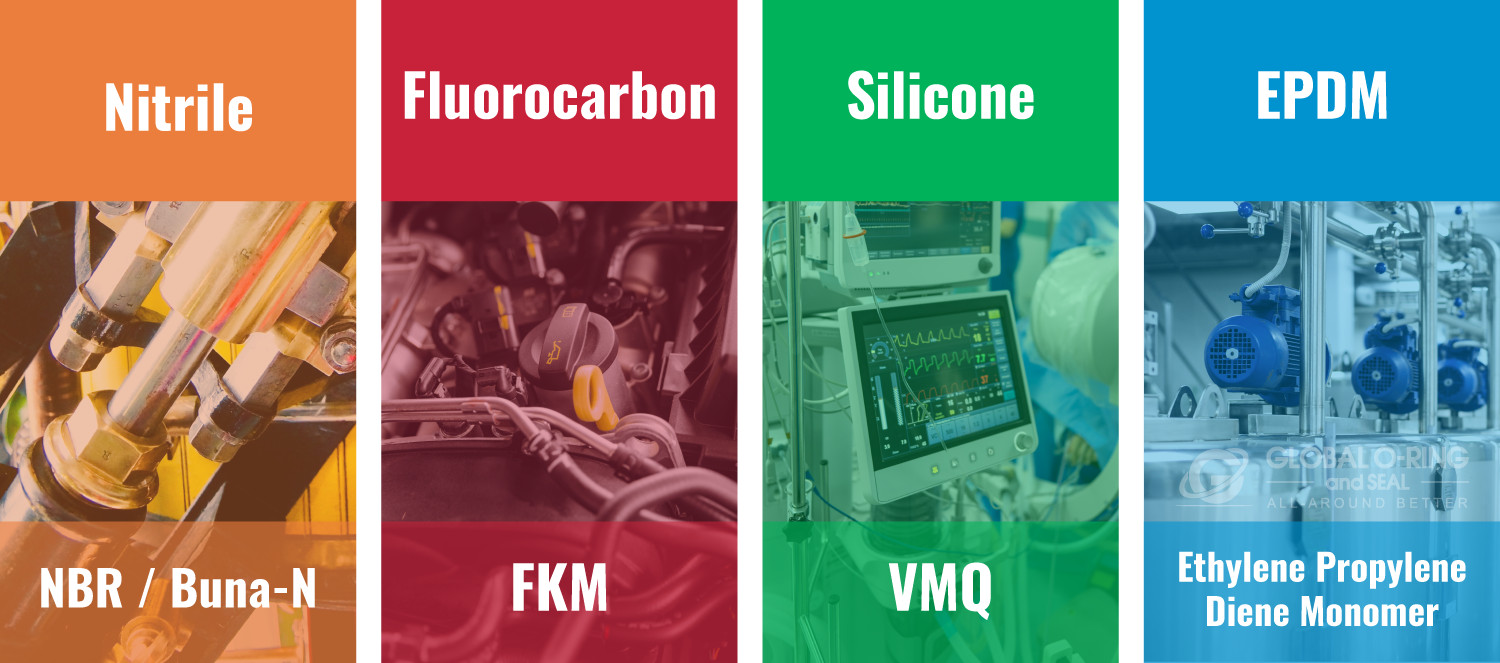
Several elastomer families account for the majority of industrial o-ring applications. While these materials are often discussed by polymer family (NBR, FKM, silicone, EPDM), actual performance depends on the specific compound formulation. Manufacturers adjust hardness, curing systems, fillers, and additives to modify properties such as compression set resistance, chemical compatibility, low-temperature flexibility, and wear resistance.
Nitrile (NBR / Buna-N)
Nitrile is one of the most widely used o-ring materials because it offers strong resistance to petroleum-based oils and fuels combined with good mechanical properties and a practical operating temperature range.
NBR performs well in many aliphatic hydrocarbons, including mineral oils, greases, and diesel fuels. Depending on the formulation, it may also be suitable for certain hydraulic fluids and water service.
A key variable in nitrile compounds is acrylonitrile (ACN) content. Higher ACN levels generally improve resistance to gasoline and aromatic solvents but reduce low-temperature flexibility. Lower ACN levels improve cold performance and compression set characteristics.
Typical applications include:
- Petroleum-based hydraulic systems
- Fuel system sealing
- General industrial machinery
- Static and dynamic sealing in oil-lubricated equipment
Fluorocarbon (FKM)
Fluorocarbon elastomers (FKM), commonly known by trade names such as Viton®, are widely used when higher temperatures and broader chemical resistance are required than nitrile can provide.
FKM materials provide strong resistance to:
- Petroleum oils and fuels
- Many hydrocarbons and lubricants
- Elevated operating temperatures
They also maintain low permeability and good compression set resistance, which helps preserve sealing force during long service periods.
However, FKM is not universally compatible with all chemicals. Performance may be limited in environments containing:
- Ketones, esters, and ethers
- Certain phosphate-ester hydraulic fluids
- Ammonia, amines, and strongly alkaline media
Typical applications include high-temperature fuel systems, engine sealing, industrial processing equipment, and chemical-resistant sealing environments.
Silicone (VMQ)
Silicone elastomers are valued for their exceptionally broad temperature flexibility, maintaining elasticity across both very high and very low temperatures.
In addition to thermal stability, silicone compounds are often used where electrical insulation, environmental sealing, or regulatory approvals are required.
However, silicone materials generally have:
- Lower tensile strength
- Reduced tear resistance
- Limited abrasion resistance
Because of these mechanical limitations, silicone o-rings are often used in static sealing applications rather than dynamic sealing environments with significant motion or friction.
Silicone may also perform poorly in contact with fuels and aromatic hydrocarbons, leading to swelling or degradation.
Typical uses include environmental seals, electronic enclosures, appliances, and regulated applications such as food or medical equipment, provided the compound meets the required approvals.
EPDM (Ethylene Propylene Diene Monomer)
EPDM is widely used in applications involving water, steam, and outdoor exposure due to its excellent resistance to ozone, weathering, and aging.
This elastomer also performs well in:
- Hot water systems
- Glycol-based brake fluids
- Phosphate-ester hydraulic fluids
A key limitation of EPDM is its poor resistance to petroleum-based oils and fuels. When exposed to these fluids, EPDM can swell significantly, leading to rapid seal degradation.
Typical applications include:
- Hot water and steam sealing
- HVAC systems
- Automotive brake systems
- Outdoor equipment and environmental sealing
- Potable water systems
Specialty O-Ring Materials
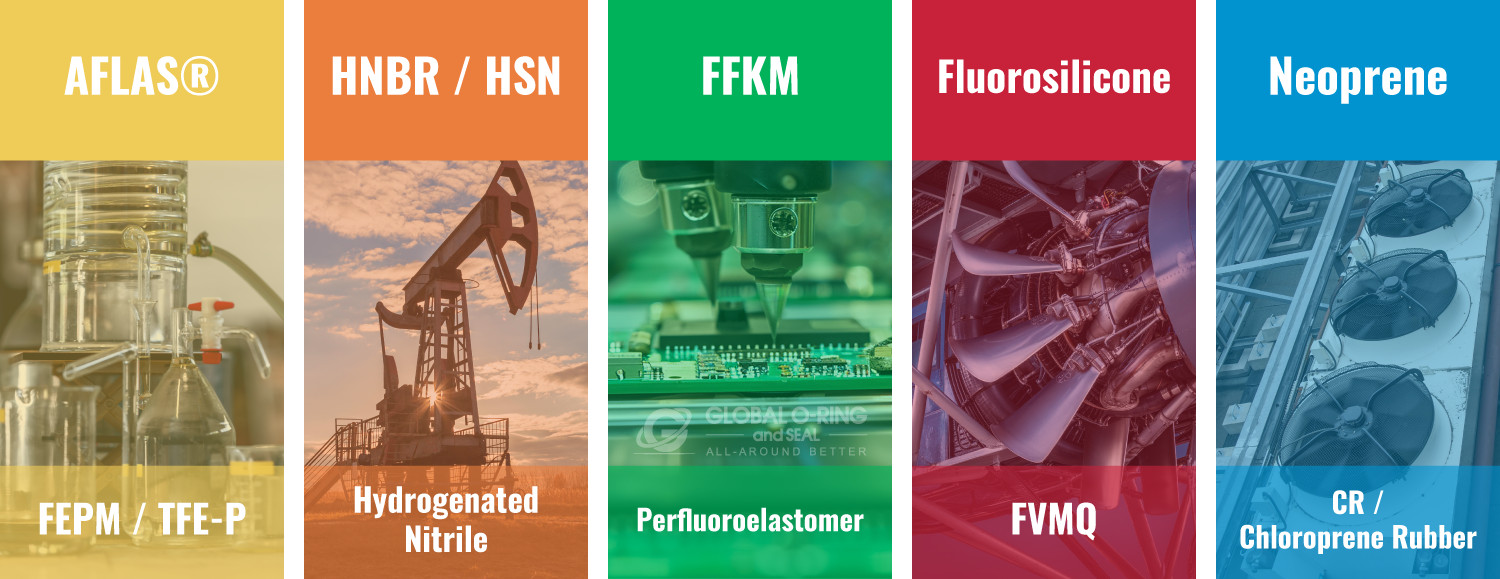
Specialty elastomers are designed for environments where common o-ring materials such as NBR, FKM, silicone, or EPDM reach their performance limits. These materials are not universally superior; instead, they solve specific challenges involving extreme temperatures, aggressive chemicals, fuel exposure, or demanding mechanical conditions.
AFLAS® (FEPM / TFE-P)
AFLAS is a tetrafluoroethylene–propylene copolymer known for its resistance to aggressive chemicals and high-temperature environments. Compared with many fluorocarbon materials, AFLAS performs particularly well in environments containing amines, bases, and steam.
The material also resists degradation from modern lubricant additive packages, making it suitable for applications involving chemically aggressive oils or process fluids.
Typical applications include:
- Chemical processing equipment
- Oil and gas systems with aggressive additives
- High-temperature industrial sealing
- Steam and amine-containing environments
HNBR / HSN (Hydrogenated Nitrile)
HNBR is produced by hydrogenating nitrile rubber, which saturates the polymer backbone and improves resistance to heat, oxidation, and chemical attack compared with standard NBR.
This modification significantly increases thermal stability while maintaining strong mechanical properties such as tensile strength and abrasion resistance.
HNBR performs well in:
- High-temperature oil environments
- Ozone and weather exposure
- Dynamic sealing applications requiring strong mechanical durability
Typical applications include automotive powertrain sealing, industrial hydraulics, and oilfield equipment where standard nitrile approaches its temperature or aging limits.
FFKM (Perfluoroelastomer)
FFKM materials offer some of the highest levels of chemical and thermal resistance among elastomeric seals. Their molecular structure provides a chemical resistance similar to PTFE while retaining the elasticity required for o-ring sealing.
Because of this combination, FFKM compounds are used when other elastomers cannot tolerate the operating environment.
Typical applications include:
- Semiconductor manufacturing equipment
- Chemical processing systems
- High-temperature industrial sealing
- Vacuum and ultra-clean environments
FFKM materials are generally selected for the most demanding sealing conditions, where extreme temperatures, aggressive chemicals, or contamination-control requirements are present.
Fluorosilicone (FVMQ)
Fluorosilicone combines the temperature flexibility of silicone with improved resistance to fuels and petroleum-based fluids. This is achieved by modifying the silicone polymer with fluorinated side chains.
The material maintains good low-temperature flexibility while providing significantly better resistance to oils and fuels than standard silicone elastomers.
Typical applications include:
- Fuel system sealing
- Aerospace and aviation components
- Automotive fuel-handling systems
- Sensor and instrumentation seals exposed to fuel vapors
Fluorosilicone is often selected when low-temperature flexibility and fuel resistance must exist in the same sealing environment.
Neoprene (CR / Chloroprene Rubber)
Chloroprene rubber offers a balanced combination of weather resistance, ozone resistance, and moderate oil compatibility, making it useful in a variety of industrial sealing applications.
It also performs well with several refrigerants and outdoor environments where exposure to ozone and weathering can degrade other elastomers.
Typical applications include:
- Refrigeration and HVAC systems
- Outdoor sealing applications
- Moderate oil and grease exposure
- Equipment exposed to ozone and weathering
How to Select the Right O-Ring Material
O-Ring material selection primarily depends on operating temperature, chemical compatibility, mechanical conditions, and regulatory requirements. Evaluating these factors systematically helps ensure the elastomer maintains sealing force and durability throughout its service life.
Evaluate Operating Temperature
Temperature strongly influences elastomer behavior and long-term sealing performance. Material selection should consider both the minimum and maximum operating temperatures, as well as the duration of exposure.
Maximum temperature should not be treated as a single limit. Short-term temperature spikes may be acceptable, while continuous exposure to elevated temperatures can accelerate material aging. Excessive heat can create additional crosslinks within the rubber, leading to hardening and permanent deformation. As elasticity decreases, the o-ring gradually loses its ability to maintain sealing force.
Low-temperature performance is equally important. If the elastomer becomes too rigid at low temperatures, the seal may lose flexibility and fail to maintain proper contact with the sealing surfaces.
Assess Chemical Compatibility
Chemical exposure is one of the most common causes of o-ring failure. Compatibility evaluation should include all fluids that contact the seal, including lubricants, cleaning agents, additives, and trace contaminants.
Additive packages in oils and fuels can significantly affect elastomer behavior. Depending on the polymer chemistry, these compounds may cause swelling, shrinkage, or chemical degradation.
Compatibility charts provide useful guidance, but when applications involve critical equipment or aggressive media, immersion testing is often recommended. Standard test methods such as ASTM D471 evaluate how rubber compounds change in volume and physical properties when exposed to liquids.
Consider Mechanical Requirements
Mechanical conditions also play a key role in o-ring material selection.
Under pressure, elastomers can deform and flow into clearance gaps between mating components. This phenomenon, known as extrusion, can lead to seal damage or leakage. In higher-pressure applications, backup rings are commonly used to support the o-ring and prevent extrusion.
Material hardness and mechanical strength also influence extrusion resistance. Softer compounds may require tighter gland clearances or additional support components to prevent seal deformation.
If the application involves dynamic motion, abrasion resistance and friction become critical considerations. Some elastomers that perform well in static sealing applications may experience rapid wear when exposed to repeated movement.
Review Regulatory and Industry Requirements
Many sealing applications require materials that meet specific regulatory or industry standards. Importantly, certification applies to individual compounds rather than the polymer family itself.
These standards ensure elastomer compounds meet safety, contamination, and performance requirements for the intended service environment.
Conclusion
O-Ring performance ultimately depends on selecting an elastomer that can maintain elasticity, sealing force, and dimensional stability within the application’s operating environment. Temperature exposure, chemical compatibility, mechanical conditions, and regulatory requirements all influence how a material behaves over time.
Common elastomers address a wide range of industrial sealing needs when applied within their performance limits. Specialty materials extend sealing capability into environments involving aggressive chemicals, extreme temperatures, fuel exposure, or demanding mechanical conditions.
A structured material selection process helps avoid common failure modes such as swelling, hardening, extrusion, and compression set. By evaluating temperature, fluid compatibility, mechanical stresses, and compliance requirements early in the design process, o-ring materials can be matched to the operating environment more effectively.
Q&A: O-Ring Materials, Applications, and Selection
Why would an O-ring fail in a fuel system?
O-Ring failure in fuel systems often occurs when the elastomer is not compatible with petroleum-based fuels. Materials such as EPDM can swell significantly when exposed to hydrocarbons, causing the seal to soften, expand, and lose dimensional stability. Replacing the seal with a fuel-resistant material such as nitrile (NBR) or fluorocarbon (FKM) restores chemical compatibility and prevents volume change, allowing the o-ring to maintain its sealing force and significantly extend service life.
What causes O-rings to fail in high-temperature applications?
High temperatures can accelerate elastomer aging, causing the material to harden, lose elasticity, and develop permanent deformation known as compression set. As the material stiffens, the o-ring can no longer maintain consistent contact with the sealing surfaces, leading to leakage. Selecting a high-temperature elastomer, such as fluorocarbon (FKM) or perfluoroelastomer (FFKM), enables the seal to retain elasticity at elevated temperatures, improving long-term sealing reliability and reducing maintenance intervals.
Why do O-rings swell when exposed to certain fluids?
O-Ring swelling occurs when the elastomer absorbs the surrounding fluid or when soluble ingredients within the rubber are extracted by the chemical environment. This volume change can distort the seal geometry, increase friction, and reduce mechanical strength. Selecting an elastomer with proven compatibility for the fluid, based on chemical resistance data or immersion testing, prevents excessive swelling and allows the o-ring to maintain proper interference and sealing performance.
What causes O-ring extrusion in high-pressure applications?
Extrusion occurs when system pressure forces the elastomer into clearance gaps between mating components. Softer compounds or large gland clearances increase the likelihood of this failure, eventually damaging the seal and causing leakage. Using a harder elastomer compound or adding a backup ring to support the o-ring prevents the material from flowing into the gap, allowing the sealing system to withstand higher pressures without extrusion damage.
Why might an O-ring wear out quickly in dynamic sealing applications?
Rapid wear often occurs when a material designed for static sealing is used in applications involving repeated motion. Some elastomers have lower abrasion resistance and can degrade quickly under friction. Selecting a material with stronger mechanical properties and better wear resistance helps the seal tolerate repeated movement, reducing friction-related damage and improving the overall lifespan of the sealing system.