 English
  Español
  Français
  Português
  Deutsch
  Italiano
  Русский
  中文
中文  日本語
日本語  العربية
  हिन्दी
Summary
- Square rings use a flat-sided cross-section that distributes load across parallel surfaces, creating stable contact and consistent compression in static sealing applications where maintaining position is critical.
- Their geometry helps resist rolling, twisting, and displacement within the gland, supporting reliable performance in environments exposed to vibration, thermal expansion, or repeated pressure cycling.
- Square rings perform best in static sealing systems that require stable compression and seal retention, while applications involving continuous motion typically require sealing elements designed to accommodate dynamic movement.
Introduction
Square rings are often viewed as a simple variation of a standard sealing element, but their geometry changes how sealing force is distributed and how the seal behaves in service. Instead of relying on a rounded profile, square rings use flat sealing surfaces to create stable contact within the gland. This difference affects compression response, positional stability, and long-term sealing consistency in static applications.
Understanding how square ring geometry influences sealing performance helps determine when the design provides a measurable advantage. In systems where maintaining seal position and consistent compression are critical, the seal’s shape can directly affect reliability and service life.
What Is a Square Ring?
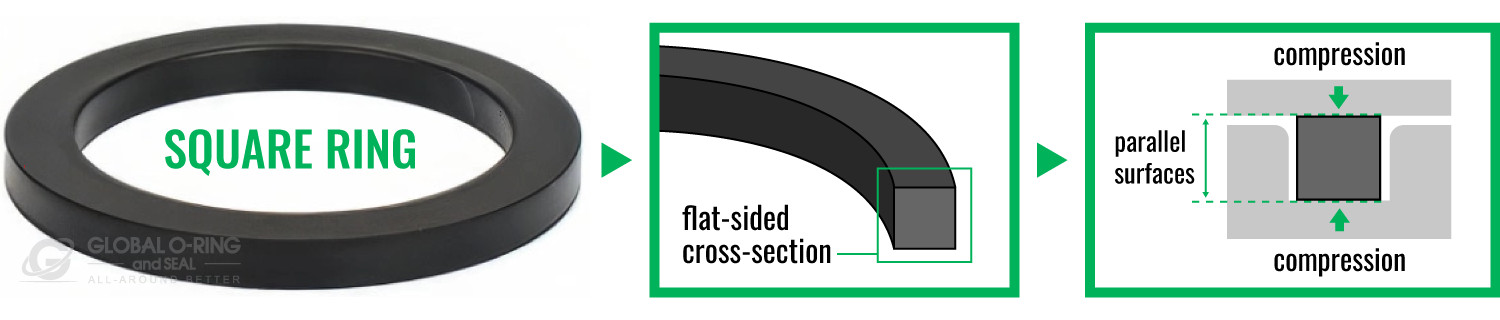
A square ring is a sealing element with a flat-sided, square or rectangular cross-section designed primarily for static sealing applications. Unlike a standard o-ring, a square ring compresses across parallel surfaces, forming stable contact between the seal and the mating hardware.
Contact Area and Compression Characteristics
Contact Stress Distribution in Square Rings
Square rings distribute load across flat faces, creating a broader contact area than a standard o-ring. This increased contact area produces a more uniform sealing interface and reduces localized stress concentrations within the sealing zone. In static systems, this balanced stress distribution helps stabilize the sealing interface and maintain consistent contact pressure required for reliable sealing.
Compression Response and Initial Sealing Force
A square ring compresses across parallel surfaces rather than deforming into a rounded contact band. This compression behavior helps establish a stable initial sealing force and maintain consistent contact between the seal and the mating hardware. Because the sealing force is distributed across a larger contact area, performance depends on controlled compression to maintain reliable sealing.
Load Retention and Long-Term Sealing Consistency
Over time, maintaining sealing force becomes critical to long-term performance. All elastomer seals experience some compression set as the material relaxes under sustained load. Because square rings distribute compression more evenly, they maintain more consistent sealing force across the contact area, supporting reliable performance in static applications.
Gland fill and compression control are essential to maintaining sealing stability. Excessive compression increases internal stress and accelerates material fatigue, while insufficient compression reduces sealing force and increases the risk of leakage. Proper dimensional control keeps the square ring within its intended compression range, ensuring consistent sealing performance throughout the system’s service life.
Stability and Seal Retention in Static Applications
Resistance to Rolling and Seal Movement
Square ring geometry helps resist rolling, twisting, and displacement within the gland. The flat sides provide greater surface contact with the surrounding hardware, limiting seal movement during installation and operation. In static sealing systems, controlling seal movement helps maintain proper positioning and prevents early misalignment.
Positional Stability Under Vibration and Pressure Cycling
Many static sealing environments experience vibration, thermal expansion, or repeated pressure changes that can gradually disturb seal position. Square rings help maintain stability under these conditions because their geometry promotes consistent surface contact and limits rotational movement. This stability helps the seal remain seated as operating conditions fluctuate.
Stable Sealing Conditions and Leak Prevention
Consistent seal position supports a stable sealing force. When a seal remains properly seated within the gland, contact pressure stays evenly distributed across the sealing interface, reducing the likelihood of localized gaps or pressure loss. Maintaining stable contact conditions helps preserve sealing integrity and reduce the risk of leakage over time.
Where Square Rings Provide the Greatest Performance Advantage
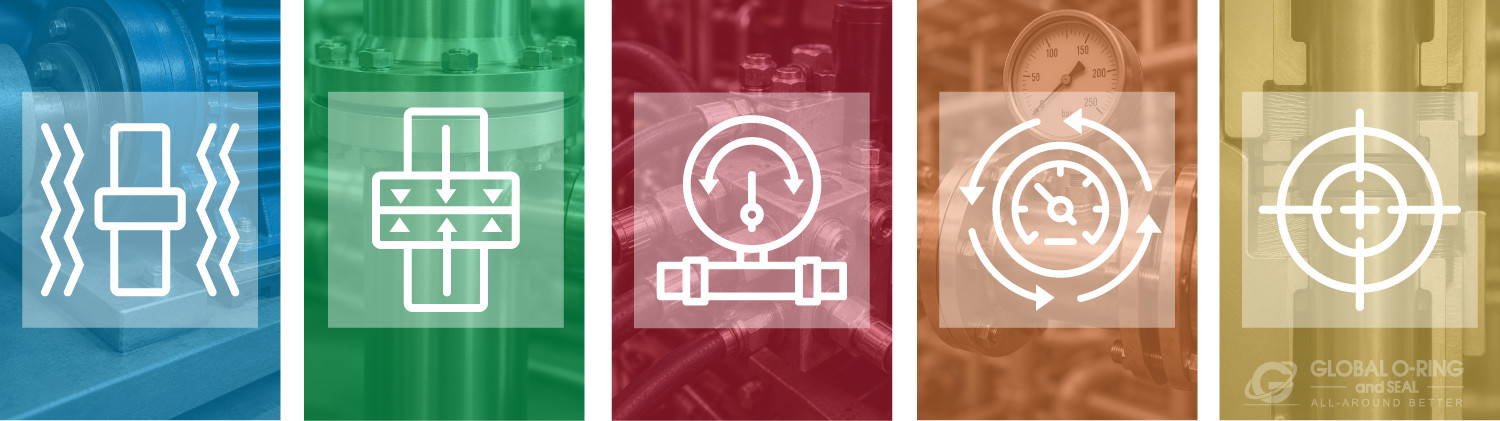
Square rings provide the greatest benefit in static-sealing environments, where maintaining seal position and consistent compression are critical to long-term reliability. These conditions commonly include:
- Static systems exposed to vibration or mechanical movement: Equipment subject to vibration, thermal expansion, or system cycling can gradually disturb seal position. Square rings help maintain stable contact and limit seal movement under these conditions.
- Flanged connections and cover plates: These interfaces depend on uniform compression to maintain sealing integrity. Square rings distribute load across flat sealing surfaces, helping maintain consistent contact pressure.
- Hydraulic and pneumatic housings: Systems operating under repeated pressure changes place a sustained load on sealing elements. Square rings help preserve stable sealing conditions as pressure fluctuates.
- Equipment subject to repeated pressure cycling: Frequent pressurization and depressurization cycles can affect seal compression over time. Square rings help maintain a consistent sealing force by distributing load evenly across the contact surfaces.
- Applications requiring precise seal positioning: Installations where seal alignment must remain stable, such as vertical assemblies or confined gland spaces, benefit from the geometry’s resistance to rolling and displacement.
Limitations of Square Rings in Dynamic Sealing
Square rings are generally not recommended for applications involving continuous motion. Their geometry is designed to support stability in static systems, not to accommodate repeated movement. In dynamic environments, the following limitations can affect performance and service life:
- Increased friction at moving interfaces: The flat-sided geometry provides greater surface contact with the mating hardware, increasing friction during motion. Higher friction can accelerate wear and generate additional heat at the sealing interface.
- Reduced ability to accommodate repeated motion: Dynamic sealing requires the seal to deform and recover continuously as components move. Square rings have limited ability to redistribute stress during movement, which can increase localized loading over time.
- Increased wear under continuous or high-cycle operation: Repeated motion places sustained mechanical demand on the sealing surfaces. Over time, this loading can accelerate material wear and reduce sealing effectiveness.
- Sensitivity to misalignment or dimensional variation: Dynamic systems often experience small changes in alignment, tolerance, or operating conditions. Square ring geometry is less forgiving of these variations, which can increase stress and reduce service life.
Conclusion
Square rings provide a practical solution for static sealing applications that demand stability and consistent compression. Their flat-sided geometry promotes uniform contact, helps maintain seal position, and supports predictable sealing performance under vibration, pressure cycling, and long-term loading conditions.
Like any sealing element, square rings perform best when their geometry matches the operating environment. When applied in stable, static systems where maintaining position and compression control are essential, square rings can improve sealing reliability and help extend service life.
Frequently Asked Questions
What problem does a square ring solve in static sealing applications?
Square rings address situations in which seal movement can disrupt compression and contact pressure. By using flat sealing surfaces that resist rolling and displacement, square rings help maintain stable positioning within the gland. This stability supports consistent sealing performance and reduces the likelihood of leakage over time.
When should a square ring be selected instead of another seal geometry?
Square rings are typically selected when maintaining seal position and consistent compression is more important than accommodating motion. In static systems exposed to vibration, pressure cycling, or dimensional variation, the geometry helps preserve alignment and contact pressure. This controlled compression supports predictable sealing performance and longer service life.
Why do square rings help maintain a consistent sealing force over time?
All elastomer seals experience compression set as materials relax under sustained load. Square rings distribute compression more evenly across flat contact surfaces, which helps maintain a more uniform sealing force. This balanced load distribution supports stable sealing conditions throughout extended operating periods.
How do square rings improve sealing reliability in vibrating equipment?
Vibration can gradually shift seal position and alter contact pressure within the gland. Square rings help limit rotational movement and maintain consistent surface engagement with the surrounding hardware. This positional stability helps preserve sealing integrity in systems subject to continuous or intermittent vibration.
When should square rings not be used in a sealing system?
Square rings are generally not recommended for applications involving continuous motion or frequent dynamic movement. Their flat-sided geometry is designed for stability rather than flexibility. Selecting a geometry suited to the operating conditions helps prevent premature wear and maintain reliable sealing performance.