 English
  Español
  Français
  Português
  Deutsch
  Italiano
  Русский
  中文
中文  日本語
日本語  العربية
  हिन्दी
Summary
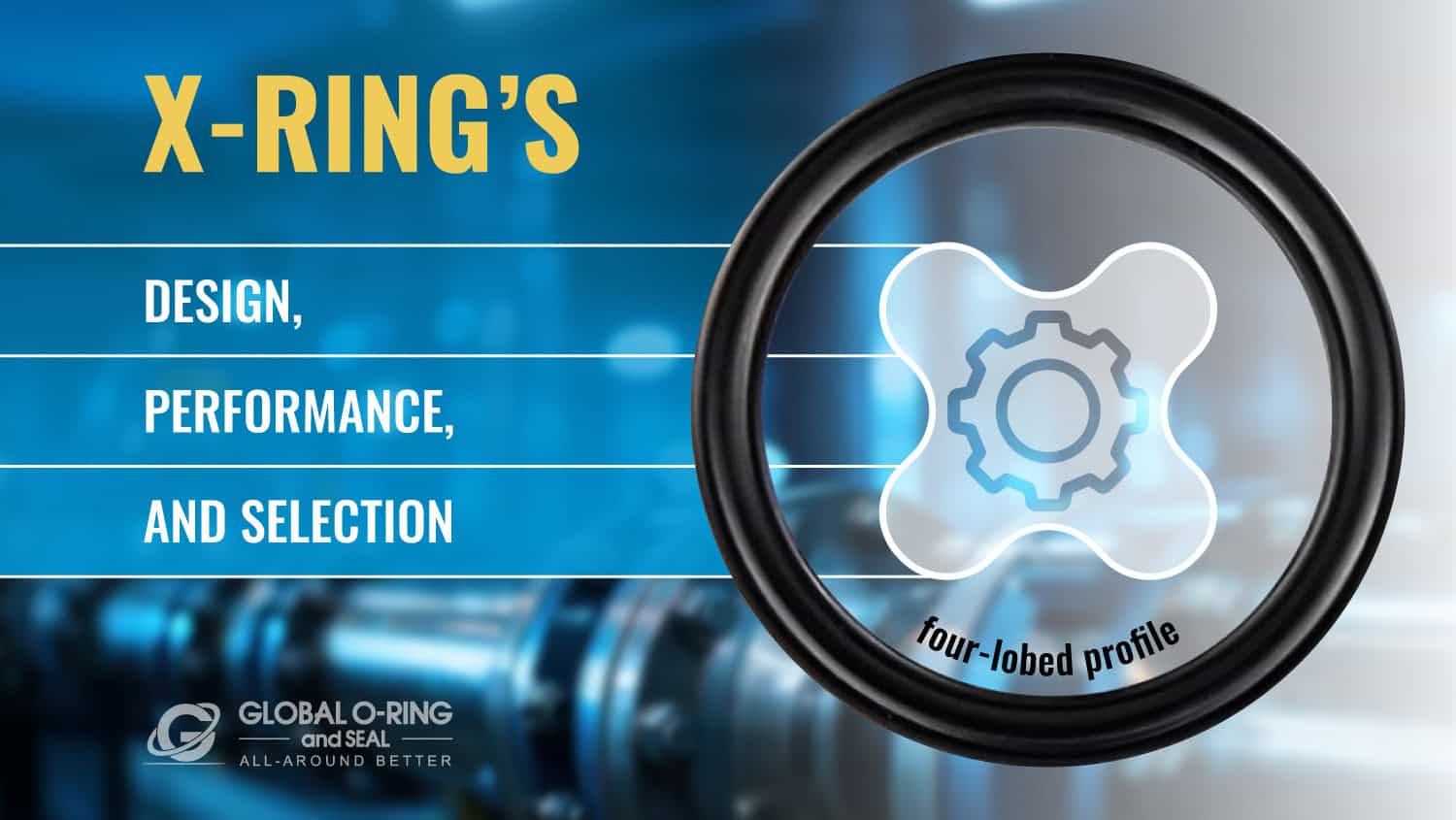
- X-Rings use a four-lobed profile to improve sealing stability, retain lubrication, reduce friction, and minimize dynamic failure risks in reciprocating and rotary motion applications.
- In dynamic sealing, x-rings resist rolling, twisting, and spiral failure while delivering lower breakaway friction, smoother motion, longer seal life, and more consistent performance overall.
- For static applications, x-rings add value only when vibration or pressure cycling exists, while standard o-rings remain the simpler, cost-effective choice for stable system designs.
Introduction
At a glance, an x-ring looks like a minor variation on a standard o-ring. Instead of a round cross-section, it features four distinct lobes. The subtle change in geometry, however, can meaningfully affect how a seal behaves.
X-Rings, often called quad rings, are not intended to replace o-rings across the board. Rather, they exist to address specific performance challenges that can arise in dynamic sealing environments, such as excessive friction, lubrication loss, rolling, or premature wear. Understanding what the geometry does, and when it matters, helps determine whether an x-ring is a smart upgrade or unnecessary complexity.
What Is an X-Ring?
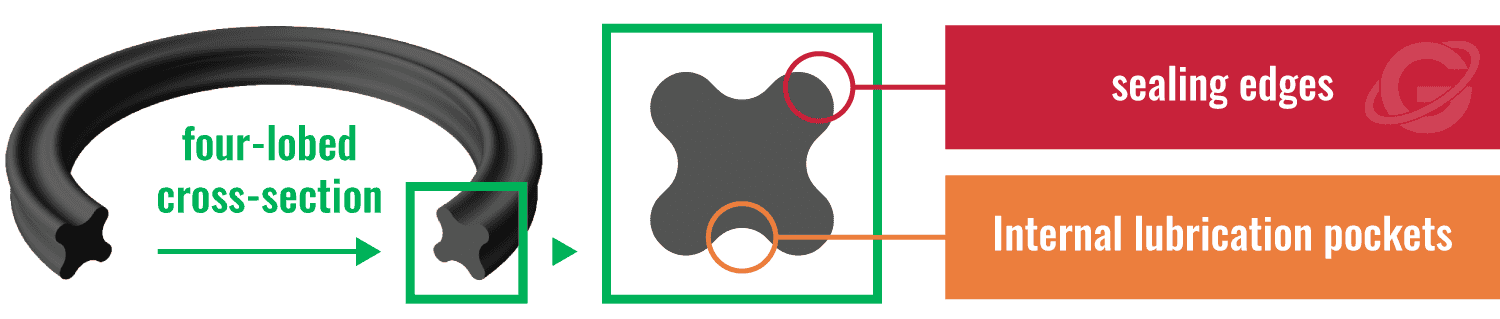
An x-ring is an elastomeric seal with a four-lobed cross-section. When viewed in profile, the shape resembles an “X”. Each lobe forms a distinct sealing edge, while the valleys between the lobes create small voids.
The geometry introduces two key differences compared to a round o-ring:
- Multiple sealing edges instead of a single primary contact line
- Internal lubrication pockets formed by the valleys between lobes
These features influence how the seal contacts mating surfaces, its behavior under pressure, and its response to motion. Geometry plays a central role in sealing performance because it affects contact stress distribution, groove stability, and friction behavior during operation.
How X-Rings Seal Compared to O-Rings
Sealing Contact: X-Rings vs. O-Rings
Compared to a standard o-ring, an x-ring forms two distinct sealing lines rather than a single line of contact, effectively doubling the active sealing surface. Because the sealing load is distributed across two contact points, an x-ring can achieve effective sealing with less required squeeze.
This distribution lowers contact stress at each sealing interface, resulting in reduced friction, less heat generation, and slower wear rates, particularly in dynamic sealing applications.
Stability in the Groove
Unlike a round o-ring, the quad profile of an x-ring resists rolling and twisting during motion. The four lobes engage the groove more positively, making it harder for the seal to rotate within the gland. This added stability is a primary reason x-rings are specified in motion-heavy systems.
Reduced Dynamic Failure Risk
Seal rolling and twisting are common precursors to dynamic failure modes such as uneven wear and spiral failure. By limiting the seal’s ability to rotate or wind up in the groove, x-rings reduce the mechanical conditions that lead to these failures.
X-Rings in Practice
The performance advantage of x-rings compared to o-rings becomes most apparent in applications involving:
- Reciprocating motion
- Directional changes
- Repeated start-stop cycles
- Long stroke lengths relative to seal size
In these conditions, x-rings often deliver more consistent sealing performance and longer service life than standard o-rings made from the same elastomer compound.
How X-Rings Reduce Friction and Retain Lubrication
X-Rings Retain Lubrication
The four-lobed geometry of an x-ring creates valleys between the lobes that serve as lubrication reservoirs. During installation, these pockets capture lubricant and help maintain a stable lubricating film between the seal and the mating surface throughout operation.
By retaining lubricant at the sealing interface, x-rings reduce direct elastomer-to-surface contact during motion. This sustained lubrication plays a key role in controlling friction, especially in reciprocating applications where lubrication loss can occur over repeated cycles.
X-Rings Reduce Breakaway Friction
Breakaway friction, or the force required to initiate movement from rest, is a critical performance factor in dynamic sealing systems. Elevated breakaway friction can lead to stick-slip behavior, inconsistent motion, and localized wear.
X-Rings are well-suited to reduce breakaway friction because their geometry supports more consistent lubrication at the sealing interface and distributes contact forces across multiple sealing lips. This helps minimize friction spikes during start-stop operation and promotes smoother system response.
X-Ring’s Improve Wear and Efficiency
Lower, more stable friction directly impacts seal performance over time. In dynamic applications, reduced friction results in:
- Lower heat generation at the sealing interface
- Reduced abrasive wear on the seal and mating surfaces
- More predictable and repeatable motion characteristics
Collectively, these effects contribute to longer seal life, improved system efficiency, and reduced maintenance requirements in applications involving frequent motion or cycling.
X-Rings in Dynamic Applications
X-Rings are most commonly specified in dynamic sealing applications, where motion-related failure modes, friction, and wear directly affect seal performance and service life.
Resistance to Spiral Failure
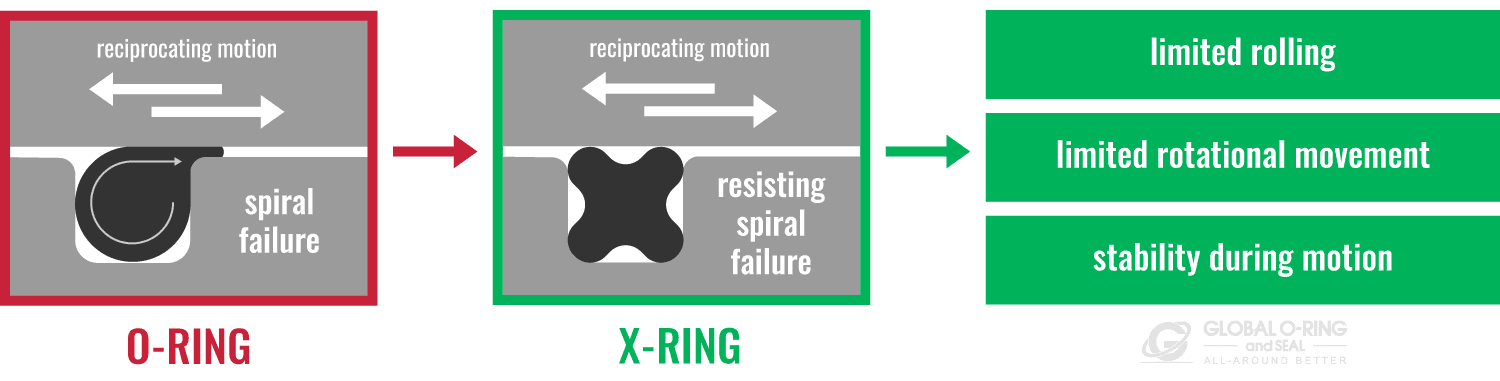
Spiral failure is a dynamic seal failure mode in which a seal twists along its circumference during reciprocating motion, eventually tearing, extruding, or losing sealing integrity. This behavior is driven by seal rolling, torsional stress, and uneven friction during operation.
X-Rings are well-suited to resisting spiral failure because their quad profile limits rolling and rotational movement within the groove. By improving seal stability during reciprocating motion, x-rings reduce the mechanical conditions that cause spiral twist and premature seal failure.
Performance In Reciprocating and Rotary Motion
X-Rings are used in both reciprocating and rotary dynamic applications, particularly where moderate speeds and repeated motion cycles are involved.
In reciprocating systems, the quad profile improves stability and wear behavior over long stroke lengths by resisting twisting and maintaining consistent contact. In rotary applications, the geometry helps prevent bunching or distortion, supporting smoother operation and more uniform wear.
Speed Considerations For Dynamic Sealing
X-Rings are not intended as a universal solution for all dynamic sealing conditions. At very high surface speeds or extreme operating temperatures, specialized seal profiles and materials may be required to manage heat buildup and friction.
X-Rings tend to perform best in moderate-speed dynamic applications, where lubrication retention, seal stability, and controlled friction are the primary drivers of seal life and reliability.
Static Applications: Are X-Rings Still Worth It?
X-Rings can be used in static sealing applications, but their advantages are more application-specific than they are in dynamic sealing. In many static systems, seal performance is primarily driven by hardware design, material selection, and compression rather than by seal profile.
Static Sealing Performance
In purely static applications with well-designed hardware, a standard o-ring typically provides reliable, effective sealing. Because there is no relative motion, the additional geometry of an x-ring does not inherently improve sealing capability under static conditions.
When pressure, temperature, and surface finish are properly controlled, both x-rings and o-rings can maintain seal integrity. In these cases, seal profile alone is rarely the limiting factor.
When X-Rings Add Value in Static Systems
X-Rings may offer measurable benefits in static applications where conditions are not perfectly static, including situations where:
- The assembly experiences vibration or micro-movement
- System pressure cycles frequently rather than remaining constant
- Additional profile stability helps prevent seal displacement over time
In these scenarios, the quad profile can provide additional resistance to movement within the groove, helping achieve more consistent long-term sealing.
When O-Rings Are the Better Choice
For stable, truly static systems, standard o-rings are often the more practical solution because:
- They are simpler to design around
- They are most cost-effective
- They are widely standardized and easy to source
In many static sealing applications, switching from an o-ring to an x-ring offers little measurable performance improvement, making the o-ring the preferred choice from both a design and cost perspective.
When Should You Choose an X-Ring?
X-Rings offer tangible benefits in dynamic applications by improving stability, reducing friction, and retaining lubrication. O-Rings remain the most efficient solution for static sealing and many simple designs. The correct choice depends on motion, environment, and failure history.
Choose an X-Ring When:
- The seal is exposed to reciprocating or rotary motion
- Seal rolling or twisting has caused past failures
- Lower breakaway friction is important
- Lubrication retention impacts wear or performance
- Spiral failure risk needs to be mitigated
Stick With a Standard O-Ring When:
- The application is static and well-controlled
- Cost sensitivity outweighs marginal performance gains
- Existing designs already perform reliably
Q&A: X-Ring’s Design, Performance, and Selection
What problems do x-rings solve compared to standard o-rings?
X-Rings address common failure risks in dynamic sealing applications where standard o-rings can experience rolling, twisting, lubrication loss, and inconsistent friction, leading to premature wear or failure. When motion, friction control, or seal stability is a concern, selecting an x-ring provides a most stable sealing solution.
When should you choose an x-ring instead of an o-ring?
X-Rings are best suited for applications that involve reciprocating or rotary motion where seal wear, stick-slip behavior, or instability has occured or is likely. When dynamic motion and cycle life are key performance concerns, selecting an x-ring helps address these challenges.
Do x-rings help prevent spiral failure?
Spiral failure occurs in dynamic sealing applications when a seal twists along its circumference during reciprocating motion, eventually tearing or extruding. When spiral failure is a known ris or has been observed, choosing an x-ring can help mitigate this failure.
Can x-rings be used in static applications?
When static conditions are not perfectly stable, selecting an x-ring can provide added resistance to seal displacement. However, in truly static, well-controlled systems, a standard o-ring often delivers equivalent sealing performance with greater simplicity and cost efficiency.
Do x-rings reduce friction in dynamic sealing?
When smoother motion and friction control are required, selecting an x-ring can help address these issues. The lubrication reservoirs formed by the quad-lobe geometry help maintain a lubricating film at the sealing interface, reducing friction spikes during start-stop operations and improving overall motion consistency.