 English
  Español
  Français
  Português
  Deutsch
  Italiano
  Русский
  中文
中文  日本語
日本語  العربية
  हिन्दी

Summary
- ISO certifications ensure consistent o-ring quality, safety, and global compatibility by standardizing dimensions, surface criteria, and quality management across manufacturing and inspection processes.
- Adherence to ISO 9001:2015 and ISO 3601 reduces defects, supports traceability, and builds customer trust in critical industries.
- Global O-Ring and Seal’s ISO-certified systems reflect our commitment to excellence, combining technical precision, operational control, and customer assurance at every stage of the supply chain.
Introduction
ISO certifications stand as globally recognized benchmarks for quality assurance. These standards help manufacturers ensure that every product meets rigorous performance, consistency, and compliance criteria. For o-ring manufacturers, adherence to ISO standards is critical. Customers rely on seals that function flawlessly under pressure, temperature extremes, and chemical exposure. ISO certifications provide the framework that makes this possible, guiding the design and the manufacturing process with measurable, repeatable criteria.
At Global O-Ring and Seal, we recognize the value of these standards not just as a requirement, but as a reflection of our core values. Our ISO-certified systems and practices directly extend our “Commitment to Excellence,” ensuring our customers receive products that meet the highest expectations—every time.
ISO Certifications and Consistency in O-Ring Manufacturing
Precision, reliability, and repeatability, driven by strict adherence to international standards, are essential for o-rings. ISO certifications are globally recognized benchmarks for quality management and technical specifications. These certifications push manufacturers to meet consistent performance, safety, and reliability standards.
For o-ring and seal production, two ISO standards stand out as particularly impactful:
- ISO 9001:2015: This standard outlines the requirements for a quality management system (QMS) and applies to any industry. In o-ring manufacturing, ISO 9001:2015 supports process consistency, customer satisfaction, and continuous improvement. The standard ensures every stage follows a structured approach built on traceability and control.
- ISO 3601: This standard focuses on o-rings by defining technical criteria that govern size tolerances, surface quality, and acceptance levels for manufacturing defects. By standardizing dimensions and quality grades, this specification ensures that o-rings perform consistently and interchangeably across global applications, reducing the risk of seal failure and enhancing the reliability of the overall system.
Together, these certifications form the foundation of a quality-first approach in o-ring manufacturing.
ISO 9001:2015 – Foundation for Quality Management

ISO 9001:2015 is the world’s most widely adopted quality management system (QMS) standard. It provides a structured framework for organizations to ensure their processes consistently meet customer and regulatory requirements while fostering continuous improvement. In the o-ring industry, this certification helps manufacturers build trust through documented, verifiable quality practices.
ISO 9001:2015 emphasizes:
- Documentation and Traceability: Thorough documentation supports every process, part, and product, enabling traceability from raw material to finished goods. This traceability strengthens quality control and simplifies issue resolution.
- Vendor Audits and Supply Chain Oversight: Rigorous procurement protocols and regular audits consistently ensure that vendors meet defined quality standards.
- Internal Audits and Preventive Actions: Ongoing internal and external audits and corrective and preventive action plans ensure that quality issues are identified, addressed, and prevented from recurring.
- Customer Satisfaction and Continuous Improvement: The standard places significant focus on meeting customer needs and improving processes over time. Companies can proactively drive improvement initiatives by monitoring performance data and customer feedback.
Global O-Ring and Seal’s ISO 9001:2015 certification reflects its unwavering commitment to these principles. It reinforces the company’s dedication to consistent quality, operational transparency, and long-term customer confidence.
ISO 3601 – Dimensional and Surface Quality in O-Rings
While ISO 9001:2015 governs the quality management system, ISO 3601 provides the technical foundation for o-ring design and inspection. It is the definitive standard for o-ring dimensional requirements and visual quality, making it essential for manufacturers, engineers, and end users who depend on consistent performance in sealing applications.
ISO 3601 plays a critical role in o-ring manufacturing by:
- Defining Standard Sizes and Tolerances: The standard establishes precise dimensional tolerances for inner diameter (ID) and cross-section (CS). This uniformity supports part interchangeability and simplifies global sourcing and inventory management.
- Establishing Quality Grades: ISO 3601 includes classifications such as Grade N for general-purpose use and Grade S for high-precision applications. These grades define permissible size and surface quality deviations, helping customers select the right product based on performance and cost requirements.
- Specifying Surface Defect Criteria: To minimize the risk of seal failure, ISO 3601 sets limits for common surface imperfections, including cracks, blisters, flash, and voids. It also defines maximum extrusion gaps to ensure the o-ring can withstand pressure without damage or displacement during operation.
By adhering to ISO 3601, manufacturers can produce o-rings that meet stringent quality thresholds, ensuring compatibility with global standards and consistent sealing performance. This compliance reduces customers’ risk of leaks, premature wear, or part rejection, particularly in high-stakes environments like aerospace, medical, or chemical processing.
ISO Certifications Drive Efficiency and Customer Confidence
ISO certifications actively enhance the way manufacturers operate and customers’ confidence in their suppliers. In the o-ring industry, ISO standards serve as operational tools and trust-building mechanisms.
For manufacturers, implementing ISO-certified systems drives internal efficiency by standardizing processes and reducing variability. This leads to:
- Fewer Defects and Less Waste: ISO standards enforce structured workflows and quality checkpoints, minimizing the likelihood of production errors and rework.
- Improved Traceability and Quality Control: Documented processes and rigorous recordkeeping make it easier to trace product history, identify root causes of issues, and implement corrective actions quickly.
- Simplified Global Compliance: Certification provides a common language for quality, easing international trade and reinforcing credibility in regulated markets.
For customers, ISO certifications offer peace of mind that the products they receive are consistent, safe, and meet the demands of their applications. Customers benefit from:
- Reliable Product Performance: Consistency in dimensions, material properties, and inspection criteria means fewer failures in the field and more predictable system behavior.
- Reduced Risk and Downtime: Dependable seals lessen the potential for leaks, equipment shutdowns, or safety incidents.
- Audit-Ready Documentation: With certified suppliers, customers can access the documentation and traceability needed for internal audits and regulatory compliance.
In short, ISO certifications build a bridge between operational excellence and customer assurance, supporting long-term trust, safety, and performance across the supply chain.
Specialized ISO and Industry Certifications Reinforcing Our Quality
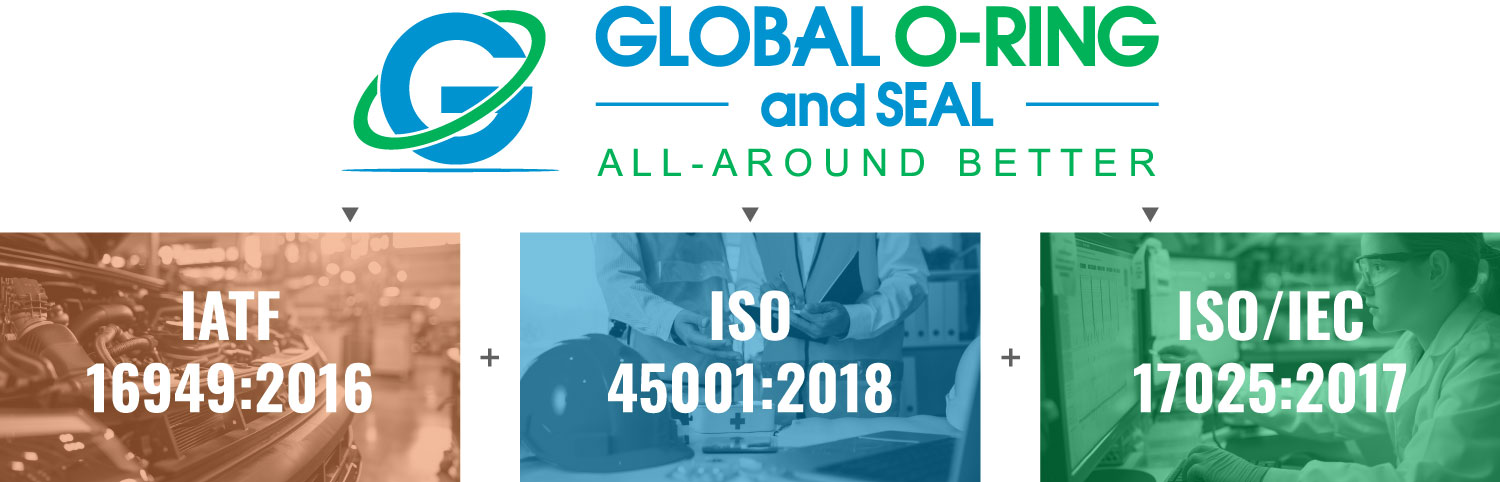
While ISO 9001:2015 forms the foundation of Global O-Ring and Seal’s quality management system, our broader certification portfolio demonstrates a more profound, specialized commitment to excellence across industries and operations. These additional certifications held by Global O-Ring and our factories reflect the complexity of modern manufacturing and the expectations of our most demanding customers.
- IATF 16949:2016 – Automotive Quality Management System: Built on the framework of ISO 9001, IATF 16949:2016 is the global standard for quality in the automotive sector. It is required by most major OEMs and Tier 1 suppliers and focuses on reducing variation, preventing defects, and driving continuous improvement throughout the supply chain.
- ISO 45001:2018 – Occupational Health and Safety Management System: Quality starts with a safe and stable work environment. ISO 45001:2018 guides our approach to workplace health and safety, helping prevent injuries and ensure compliance with legal and regulatory obligations.
- ISO/IEC 17025:2017 – Laboratory Competence: Accuracy and reliability in testing are vital for quality assurance. ISO/IEC 17025:2017 confirms that our laboratories meet the highest standards of technical competence for testing and calibration. Through routine conformity assessments, proficiency testing, and robust data management, we ensure that material, dimensional, and performance test results are valid and defensible.
These specialized certifications support a fully integrated quality ecosystem where internationally recognized best practices govern every production stage.
Why ISO Certifications Will Continue to Shape the Future of O-Rings
As industries evolve and performance demands grow more complex, ISO certifications will remain essential to the future of o-ring manufacturing. These standards provide more than just compliance—they offer a universal language for quality, safety, and consistency across global markets. By ensuring precise specifications, transparent processes, and verifiable testing, ISO certifications help manufacturers meet the needs of critical applications while fostering trust with their customers.
At Global O-Ring and Seal, our ISO-driven approach reflects a deep, ongoing commitment to excellence. These certifications form the backbone of our operations. They are not only a validation of our processes, but a promise to our customers: that every seal we deliver meets the highest performance and reliability standards. This commitment to excellence remains central to who we are and how we help our customers succeed.